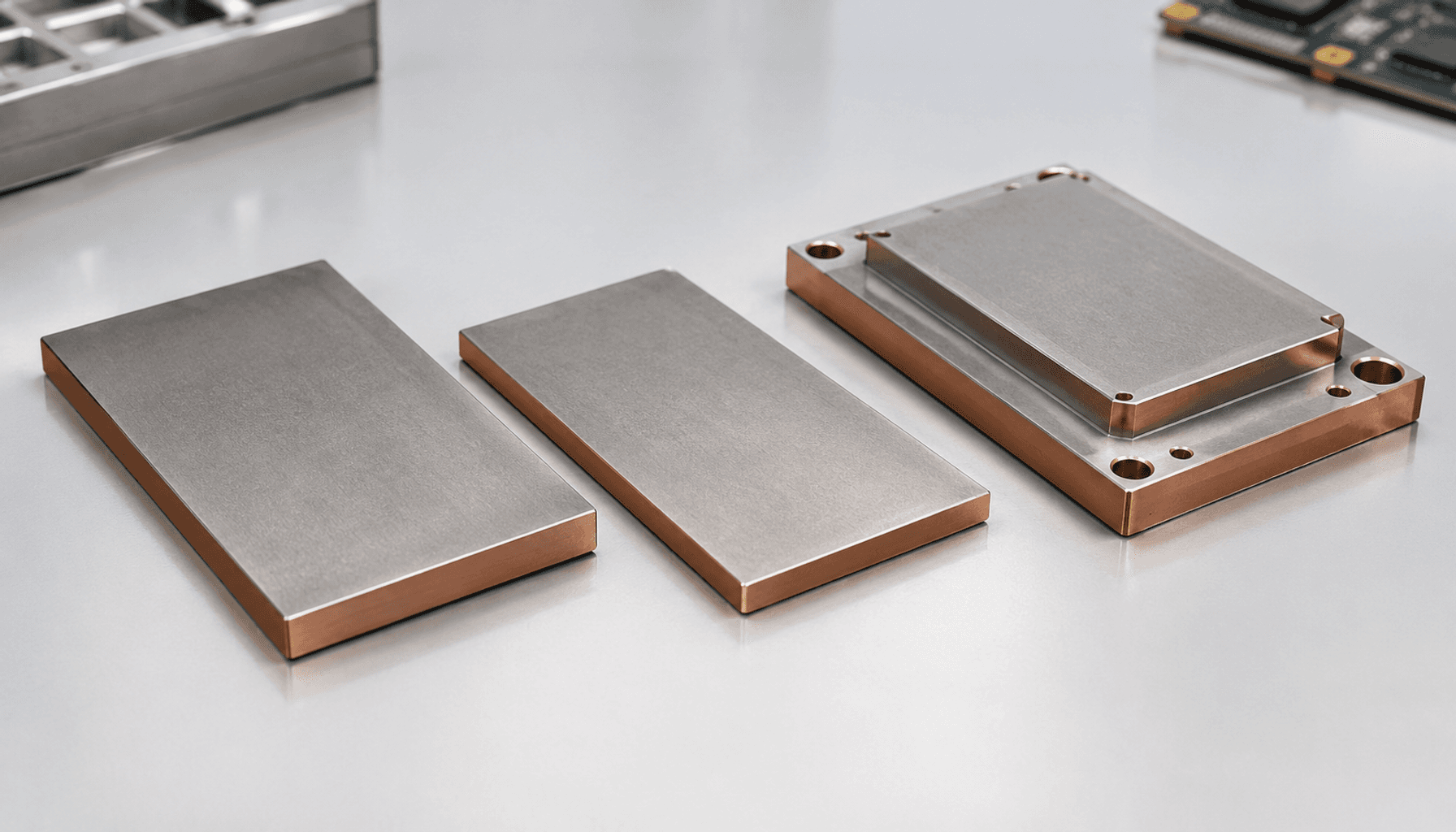
WCu Heat Sinks: Composition and CTE Selection
Compare nominal W70Cu30, W80Cu20, and W90Cu10 compositions for electronic packaging. Learn how to assess CTE, thermal conductivity, interfaces, drawing…
Table of Contents
- How WCu Heat Sinks Support Electronic Packaging
- Define CTE, Thermal Conductivity, and Thermal Resistance
- Comparison Table: W70Cu30, W80Cu20, and W90Cu10
- Why Property Values Need a Temperature Range
- Match the Heat Spreader to the Package Stack
- Interface Materials, Flatness, and Surface Requirements
- Specification Summary for Custom WCu Thermal Parts
- Five Steps from Package Requirements to a Qualified Sample
- Buyer FAQ: Composition, Tolerances, Records, and Delivery
- Request a Quote for Custom WCu Heat Sinks
WCu heat sinks combine tungsten’s relatively low thermal expansion with copper’s thermal conductivity, making them candidates for electronic packages where dimensional compatibility and heat flow both matter. Choose the composition against the full package stack and operating temperature range, then confirm property values and measurement conditions with your supplier.
How WCu Heat Sinks Support Electronic Packaging
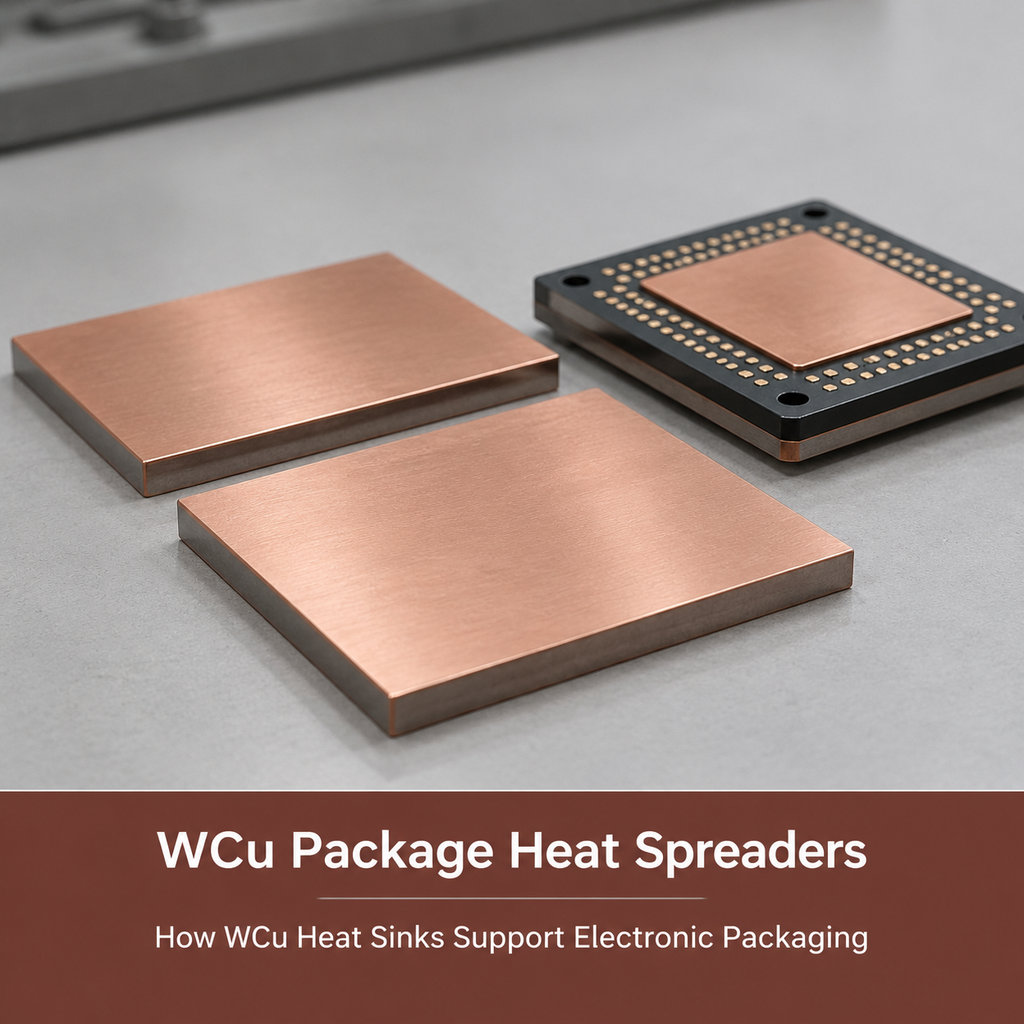
WCu heat sinks and heat spreaders are used in electronic packages when the designer needs to move heat while managing expansion relative to adjacent materials. Tungsten contributes lower thermal expansion than copper; copper contributes thermal conduction. The balance depends on composition, part geometry, processing, and the property data confirmed for the supplied grade.
Applications can include package bases, heat spreaders, and components in RF devices or power modules. The relevant design question is not simply whether WCu conducts heat: it is whether the complete thermal path and package stack meet temperature limits without unacceptable stress, warpage, or interface degradation. See our WCu thermal management parts for electronic packaging applications.
Practical takeaway: Treat WCu as one element in a package design, not a drop-in guarantee of lower device temperature.
Define CTE, Thermal Conductivity, and Thermal Resistance
Coefficient of thermal expansion (CTE) describes how much a material changes dimension as temperature changes. It is commonly reported in ppm/K, or parts per million per kelvin. A lower CTE may improve expansion compatibility with a package substrate or ceramic, but compatibility depends on the actual materials, geometry, temperature cycle, and joint design.
Thermal conductivity describes a material’s ability to conduct heat, often reported in W/(m·K). Thermal resistance describes the temperature rise across a component or assembly for a given heat flow, commonly in K/W. It includes more than bulk material: thickness, contact area, interface materials, surface condition, and contact pressure all affect the total path.
Practical takeaway: Compare conductivity as a material property, but validate the complete assembly’s thermal resistance and mechanical behavior.
Comparison Table: W70Cu30, W80Cu20, and W90Cu10
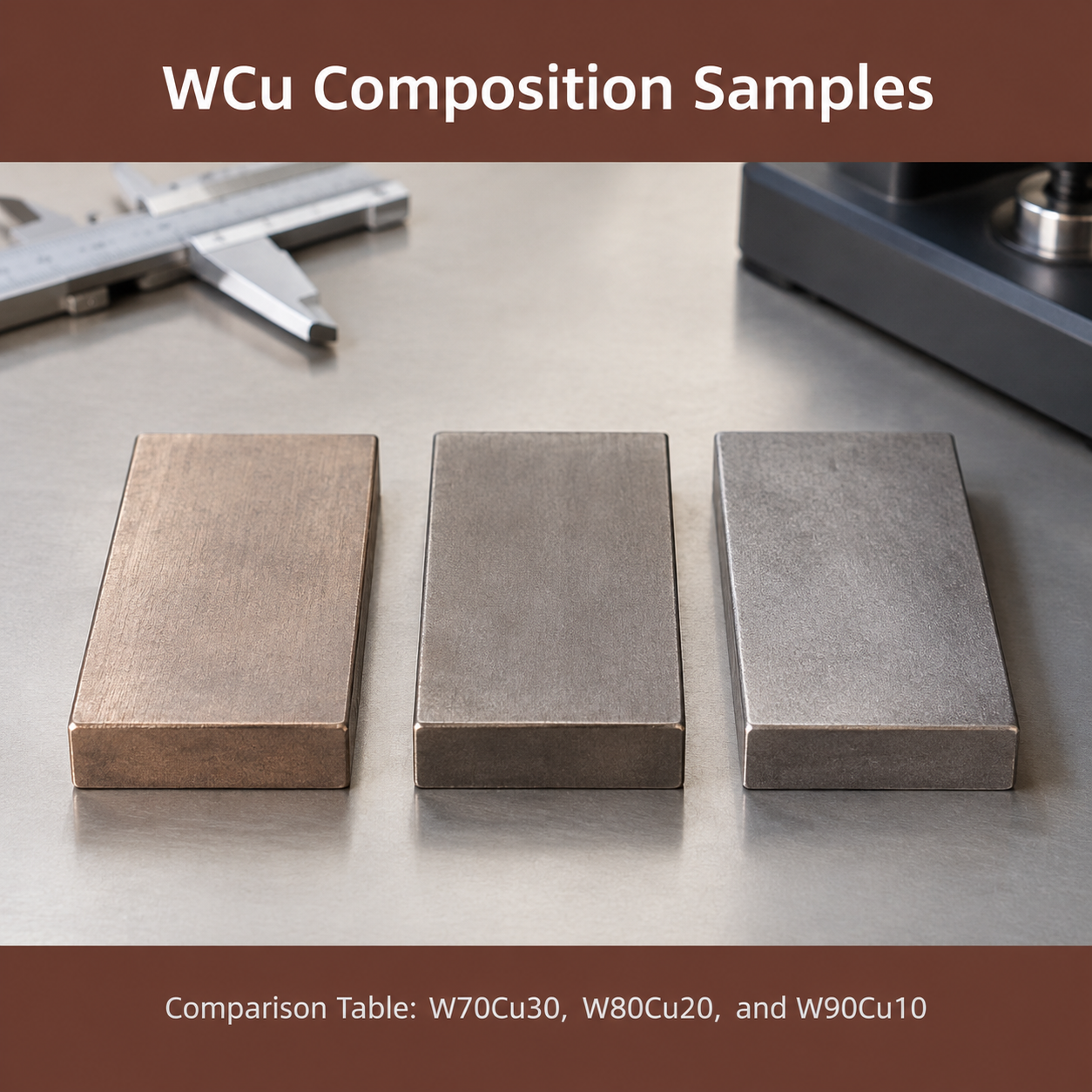
W70Cu30, W80Cu20, and W90Cu10 refer here to nominal weight percentages of tungsten and copper, respectively. As tungsten content increases, the composition generally shifts toward lower expansion and lower thermal conductivity; the exact values depend on the material route and must be supplier-confirmed.
| Nominal composition (wt%) | General selection tendency | Evaluation focus |
|---|---|---|
| W70Cu30 | Higher copper fraction; generally favors heat conduction among these examples. | Check whether expansion compatibility is adequate for the adjacent substrate and joining method. |
| W80Cu20 | Intermediate tungsten-to-copper balance. | Compare measured CTE and conductivity with the package requirements over the operating range. |
| W90Cu10 | Higher tungsten fraction; generally favors lower expansion among these examples. | Confirm the thermal path still meets the device’s heat-flow requirements. |
These are qualitative tendencies, not guaranteed grade data or a substitute for a specification. Ask for the proposed grade’s composition basis, density, CTE, conductivity, test method, and measurement temperature range. Our tungsten copper alloy components cover the broader WCu product family.
Practical takeaway: Select the tungsten fraction by balancing the package’s expansion constraint against its thermal requirement, then verify with grade-specific data.
Why Property Values Need a Temperature Range
CTE and thermal conductivity can vary with temperature, and reported results may also depend on the test method, specimen condition, and material processing. A single number without a temperature range cannot show whether the property represents room-temperature screening or the component’s intended operating conditions.
Request the source and conditions for every quoted value, including measurement range and method where available. If the supplier cannot provide a value across your operating range, agree on what data is available and whether additional testing is needed before design release.
Practical takeaway: Use supplier-confirmed values tied to defined measurement conditions; do not treat generic composition tables as guaranteed performance.
Match the Heat Spreader to the Package Stack

Choose a WCu composition by assessing the entire stack: heat source, die attach or joining layer, substrate, spreader, and downstream cooling surface. Compare the CTE of the WCu candidate with the neighboring materials and consider how constrained the part is. A thin, bonded spreader in a multilayer package may respond differently from a mechanically clamped base.
For thermal performance, define heat load, contact area, allowable temperature rise, and the interfaces in the path. Model or test the assembly where required; bulk conductivity alone does not include interface resistance or heat spreading within the actual geometry. Zhuzhou Weison Advanced Materials Co., Ltd. supplies drawing-based tungsten and carbide products through Tungstenmetal.
Practical takeaway: Start from package-level limits, then choose composition and geometry together rather than selecting a nominal alloy by name alone.
Interface Materials, Flatness, and Surface Requirements
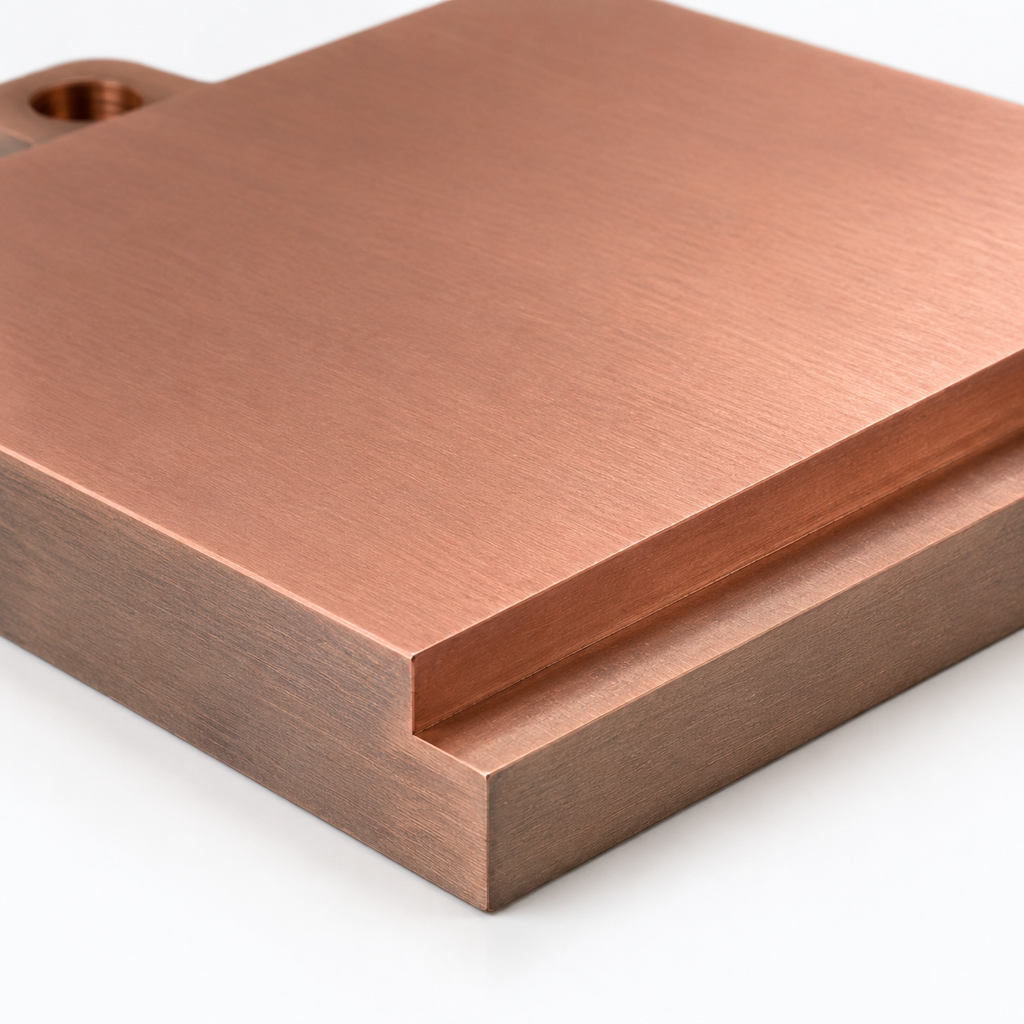
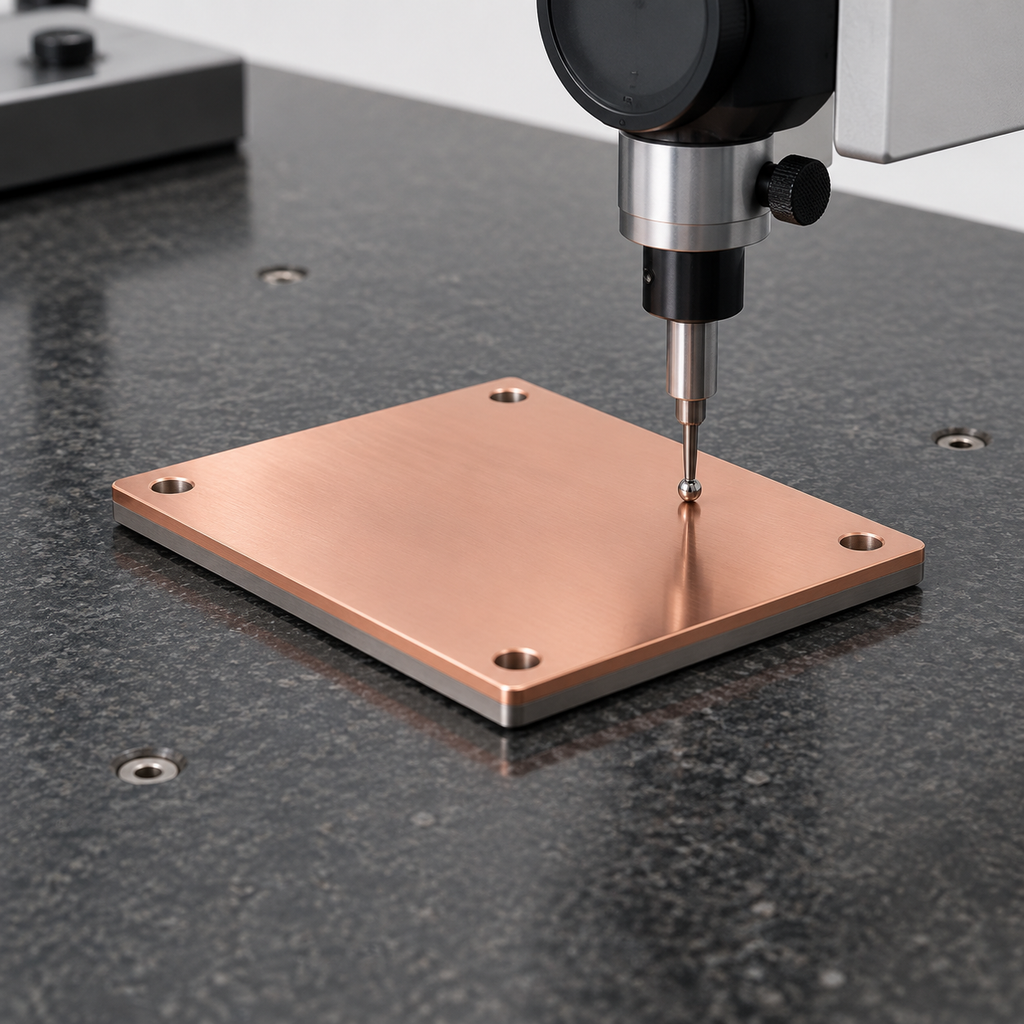
Put functional interface requirements on the drawing rather than assuming a standard finish. Specify thickness and dimensional tolerances, flatness over a defined datum or inspection area, surface finish where it affects bonding or contact, edge condition, holes, and any metallization or coating requirement. State units, datums, and inspection method for critical features.
Also identify the joining or clamping method and any interface material, such as a thermal interface layer, braze, or solder, if relevant to your design. These choices affect contact and total thermal resistance. A drawing should distinguish required characteristics from preferred targets so manufacturing and inspection can assess feasibility.
Practical takeaway: Define the interface as an engineered feature, including measurable flatness and surface requirements. See our drawing-based manufacturing capabilities when preparing custom part requirements.
Specification Summary for Custom WCu Thermal Parts
A useful RFQ package states the material target and the conditions the part must meet. Include:
- Nominal composition and whether percentages are weight-based, plus requested grade or allowable alternatives.
- Operating and storage temperature range, heat load, package stack, joining method, and required thermal performance.
- Finished dimensions, thickness, tolerances, datums, flatness, surface finish, and edge requirements.
- Metallization or coating specification, if required, including coverage and critical areas.
- Quantity for prototype and production, inspection scope, property data, and required records.
Ask whether the supplier can provide composition documentation, dimensional inspection records, and available thermal property data for the proposed grade and batch. Do not assume a particular certificate, test, tolerance, or coating capability; have it confirmed against the drawing and purchase specification.
Practical takeaway: A complete specification connects the material, geometry, interface, verification, and quantity in one reviewable package.
Five Steps from Package Requirements to a Qualified Sample
- Define package constraints. Share the full material stack, operating temperature range, heat load, and joining method.
- Set composition targets. Identify the required CTE and thermal performance, then compare candidate WCu compositions using supplier-confirmed data.
- Issue a controlled drawing. Mark critical dimensions, thickness, flatness, surface finish, and any metallization requirements.
- Agree on verification. Specify composition or material records, dimensional inspection, and thermal property documentation needed for qualification.
- Review a sample before release. Check dimensions and interfaces, then assess the part in the intended package assembly under representative conditions.
MOQ and lead time depend on composition availability, part geometry, machining and finishing steps, inspection scope, and production quantity. A prototype may use a different planning route from repeat production; request separate prototype and production quotations with stated assumptions.
Practical takeaway: Share quantities and qualification requirements early so the supplier can confirm MOQ, schedule, inspection scope, and packaging before order placement.
Buyer FAQ: Composition, Tolerances, Records, and Delivery
Practical takeaway: Put performance, inspection, and delivery expectations in the RFQ and confirm supplier capability before approving the order.
Request a Quote for Custom WCu Heat Sinks
For custom WCu heat sinks, tungsten copper heat spreaders, or package bases, send a drawing, sample, or application description. Include the target grade or nominal composition, dimensions and tolerances, quantity, working conditions, required records, and destination. We can review the requirements and confirm quotation details, lead time, and packaging arrangements for shipment to the United States.
FAQ
How should I choose a WCu composition for my package?
Compare the package’s CTE compatibility and heat-flow requirement together. Higher tungsten fractions such as nominal W90Cu10 generally favor lower expansion, while higher copper fractions such as W70Cu30 generally favor greater thermal conductivity. Confirm values and measurement temperature ranges for the proposed grade, then validate the complete assembly.
Which tolerances and surface requirements belong on a WCu heat sink drawing?
Specify finished dimensions and thickness, datums, critical dimensional tolerances, flatness over a defined area, surface finish where it affects contact or bonding, edge condition, and any metallization or coating. State units and inspection requirements; confirm achievable tolerances with the supplier before release.
What determines MOQ and lead time for prototype and production parts?
MOQ and lead time depend on material availability, geometry, machining and finishing route, inspection scope, and quantity. Request separate prototype and production quotations that state schedule assumptions and any minimum quantity for the selected composition or process.
Which material certificates and inspection data should I request?
Request available composition or batch material documentation, dimensional inspection results for critical features, and supplier-confirmed CTE and thermal conductivity data with test method and temperature range where available. State any traceability or qualification records required in the purchase specification; do not assume a certificate or test is included unless confirmed.
How should finished surfaces be packaged for shipment to the United States?
Specify protection for finished interface faces, such as individual separation and suitable surface protection, and require packaging that prevents abrasion, impact, and contamination in transit. Confirm the packaging plan, labeling, and export shipment details with the supplier before dispatch.