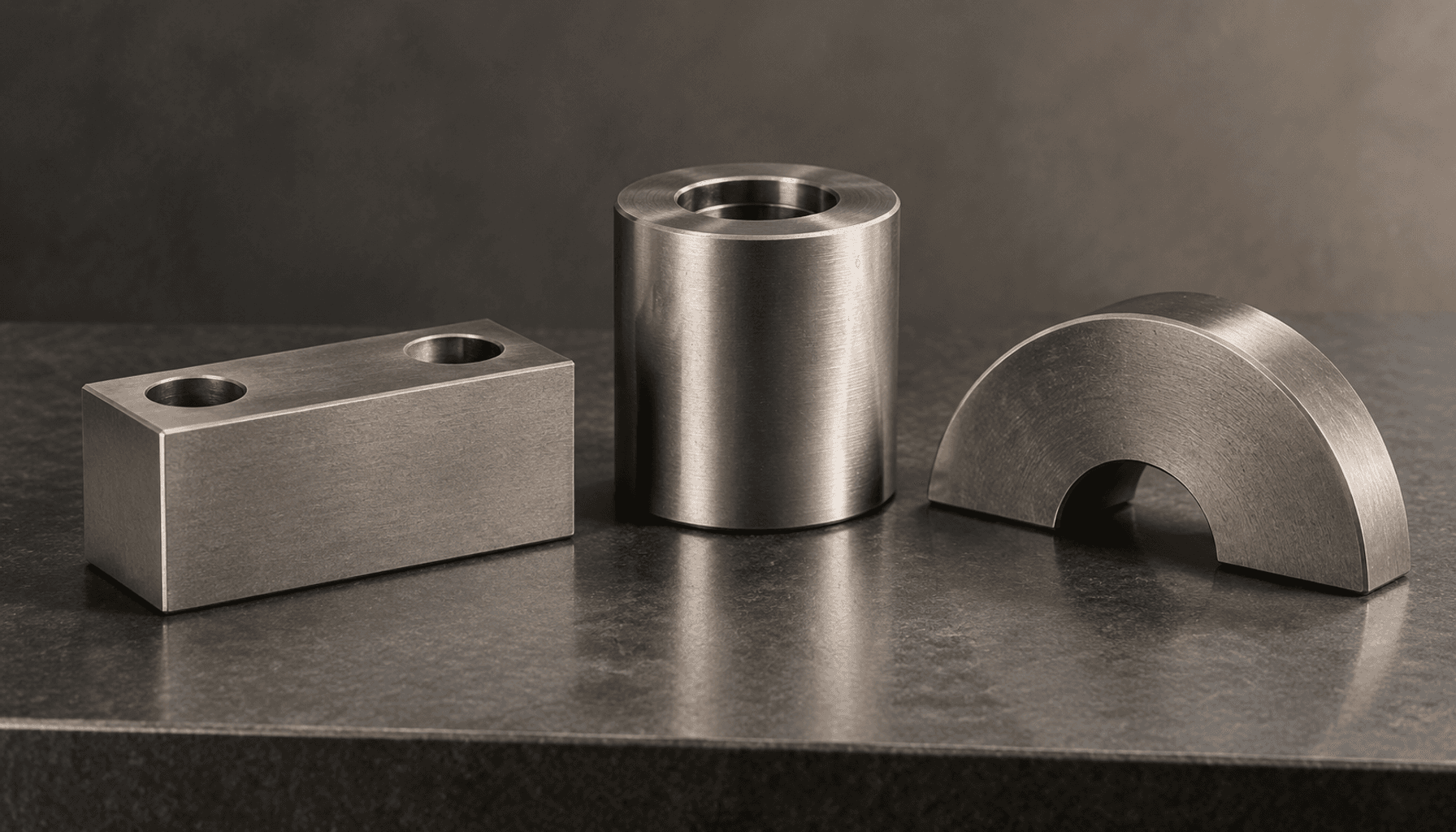
Tungsten Heavy Alloy Counterweights: WNiFe vs WNiCu
Compare WNiFe and WNiCu for space-constrained counterweights, calculate the volume needed for a target mass, and establish separate requirements for…
Table of Contents
- Selecting Tungsten Heavy Alloy Counterweights
- Comparison Table: WNiFe and WNiCu
- Density, Mechanical Properties, and Magnetic Response
- Calculate Counterweight Volume from Target Mass
- Worked Example: A 1 kg Weight in a Restricted Envelope
- Specification Summary: Mass, Dimensions, and Acceptance Criteria
- Separate Mass Tolerance from Dimensional Tolerance
- Five Steps to Specify and Qualify Custom Counterweights
- Buyer FAQ: Grades, Tolerances, Orders, and Delivery
- Request a Quote for Custom Tungsten Alloy Counterweights
Tungsten heavy alloy counterweights typically provide densities of approximately 17.0–18.5 g/cm3, allowing a 1 kg weight to occupy just 54.1–58.8 cm3. Choose WNiFe when mechanical performance is the priority and magnetic response is acceptable; consider WNiCu when low magnetic response matters, then verify the selected grade against your actual acceptance criteria.
Selecting Tungsten Heavy Alloy Counterweights
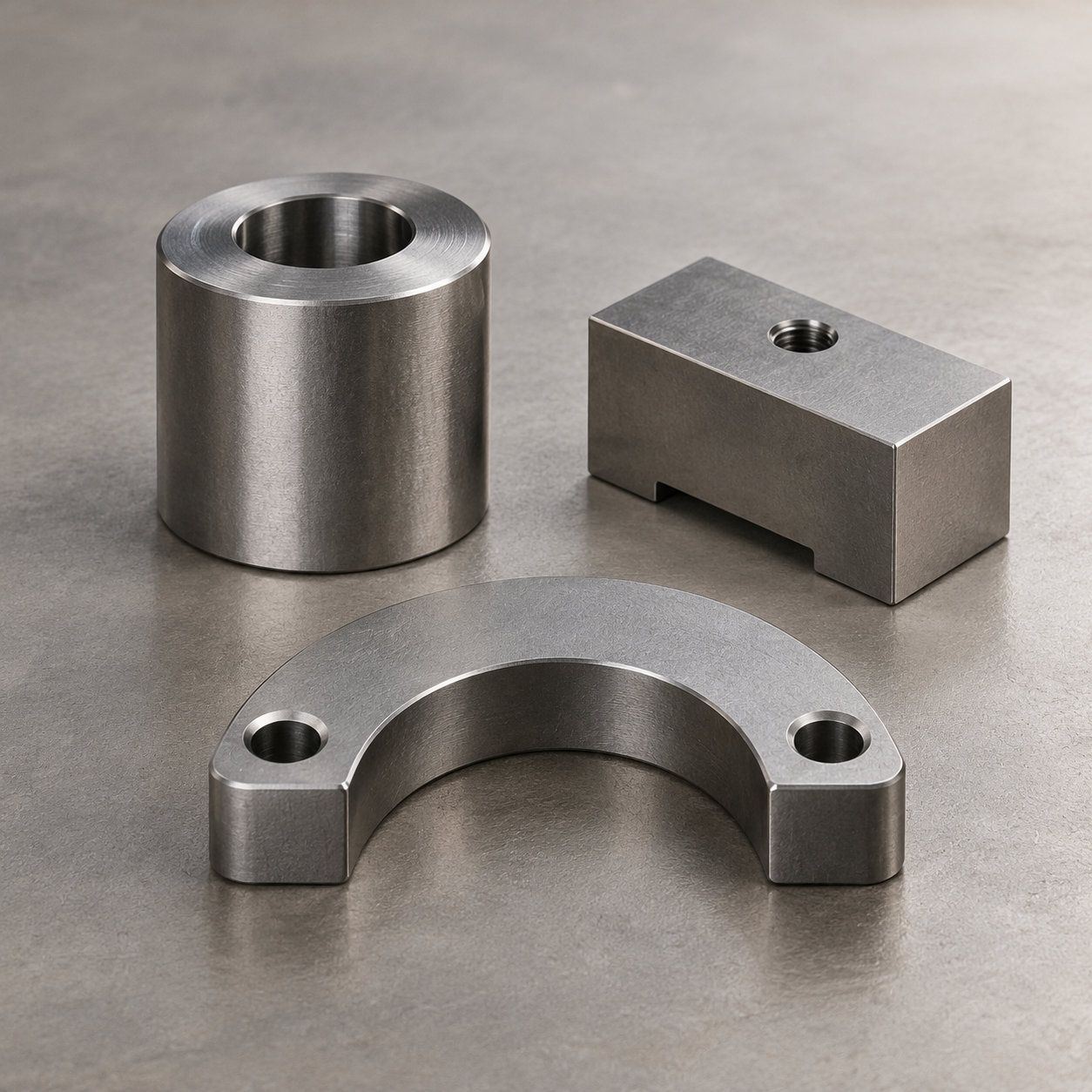
Start with the required mass and available envelope, then screen the binder system for magnetic and mechanical compatibility. For rotating assemblies, also specify the center of gravity and balance requirement: mass alone does not establish balancing performance.
These materials are commonly consolidated by liquid-phase sintering, a thermal process in which the binder becomes liquid while tungsten remains solid. Our tungsten heavy alloy balance components can be specified as blanks or finished parts.
Takeaway: Select high density balance weights by usable volume and operating constraints—not density alone.
Comparison Table: WNiFe and WNiCu
The main WNiFe vs WNiCu distinction is the binder, which affects magnetic response and mechanical behavior. The following figures are typical selection references, not guaranteed properties or a stocked-grade list.
| Selection factor | WNiFe | WNiCu |
|---|---|---|
| Common tungsten content | Approximately 90–97 wt.% | Commonly approximately 90–95 wt.% |
| Typical density across these compositions | Approximately 17.0–18.5 g/cm3 | Approximately 17.0–18.0 g/cm3 |
| Illustrative nominal composition | 95W–3.5Ni–1.5Fe, wt.% | 90W–6Ni–4Cu, wt.% |
| Magnetic response | Generally magnetic | Generally low magnetic response; verify against the specified limit |
| Mechanical selection | Generally preferred for strength and ductility at comparable tungsten content and processing | Often selected for magnetic compatibility; strength and ductility can be lower |
| Typical counterweight priority | Loaded mounting features, impact exposure, compact balance masses | Weights near magnetically sensitive instruments or assemblies |
Takeaway: Do not transfer density or mechanical-property requirements between binder systems without checking the actual grade.
Density, Mechanical Properties, and Magnetic Response
Higher tungsten content generally increases density, but does not automatically improve toughness or mounting reliability. Composition, porosity, heat treatment, and subsequent processing influence the finished material.
For loaded or high-speed applications, request grade-specific tensile strength in MPa and elongation in percent, then evaluate attachment stresses. Near sensors or magnetic fields, replace an ambiguous “nonmagnetic” note with a relative-permeability limit or an assembly-level disturbance limit, including the test conditions.
Takeaway: WNiCu is a starting point for low magnetic response, not a substitute for a measurable acceptance test.
Calculate Counterweight Volume from Target Mass
Divide target mass by the selected grade’s density to obtain the required finished material volume. Use net volume after subtracting bores, pockets, chamfers, and other removed features.
- Convert mass to grams and volume to cm3.
- Calculate V = m / ρ, where V is volume, m is mass, and ρ is density.
- Compare that volume with the usable envelope and allow for final mass adjustment.
For a simple block, V = length × width × height; 1 cm3 equals 1,000 mm3. Do not use pure tungsten’s density for a heavy-alloy calculation.
Takeaway: Check feasibility using the grade’s agreed density range, not only its nominal value.
Worked Example: A 1 kg Weight in a Restricted Envelope
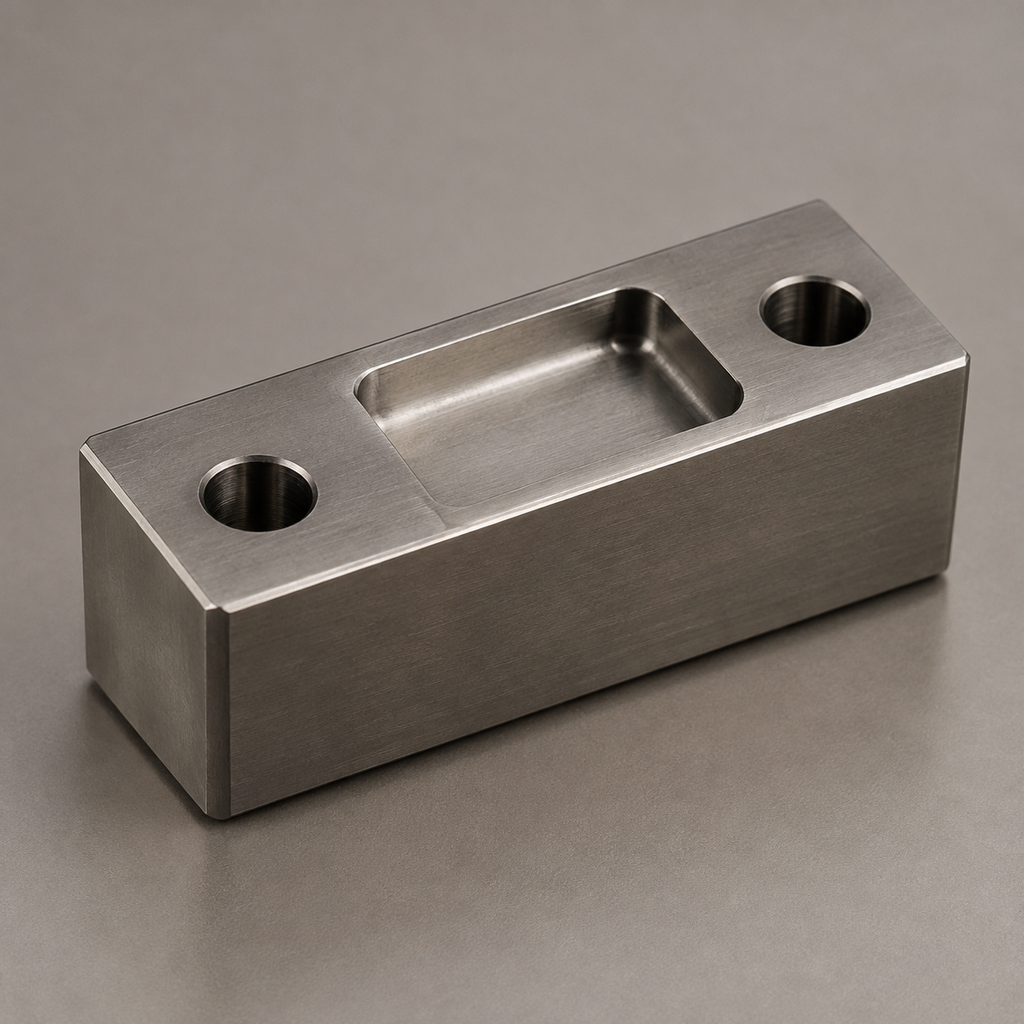
A 1 kg counterweight requires approximately 54.1–58.8 cm3 across a density range of 18.5–17.0 g/cm3. Suppose your maximum envelope is 50 × 40 × 30 mm, giving 60 cm3, and required mounting features remove 3 cm3: maximum usable material volume is 57 cm3.
| Density, g/cm3 | Required volume, cm3 | Fits within 57 cm3? |
|---|---|---|
| 17.0 | 58.8 | No |
| 17.6 | 56.8 | Yes, with limited margin |
| 18.0 | 55.6 | Yes |
| 18.5 | 54.1 | Yes |
The mathematical minimum density is 1,000 / 57 = approximately 17.54 g/cm3. At 18.0 g/cm3, a full 57 cm3 part weighs 1,026 g; reducing it to 1,000 g requires removing approximately 1.44 cm3 from a permitted trim area.
Takeaway: Reserve an adjustable feature without moving critical mounting datums or violating the balance geometry.
Specification Summary: Mass, Dimensions, and Acceptance Criteria
A purchase-ready specification separates material identity, finished geometry, and functional acceptance. Use this summary for custom tungsten counterweights; the numerical entries below are illustrative design requirements, not advertised manufacturing limits.
| Item | What you should specify |
|---|---|
| Product and delivery state | Counterweight block, cylinder, or balance segment; blank, semi-finished, or finished to drawing |
| Material | WNiFe or WNiCu, agreed composition, density range, and required mechanical properties |
| Finished mass | For example, 1,000 ± 2 g per part; define whether hardware is included |
| Dimensions | Maximum envelope, datum references, mounting fits, geometric tolerances, and surface finish |
| Magnetic acceptance | Specified limit, test method, applied field, and relevant part condition |
| Balance acceptance | Center-of-gravity location and residual unbalance limit where applicable |
| Records | Batch material certificate, density results, mass records, and critical dimensional report |
Agree the sampling plan and measurement methods during quotation. Our tungsten component quality control information describes density, dimensional inspection, and batch documentation.
Takeaway: Record acceptance criteria in the drawing or purchase specification before production begins.
Separate Mass Tolerance from Dimensional Tolerance
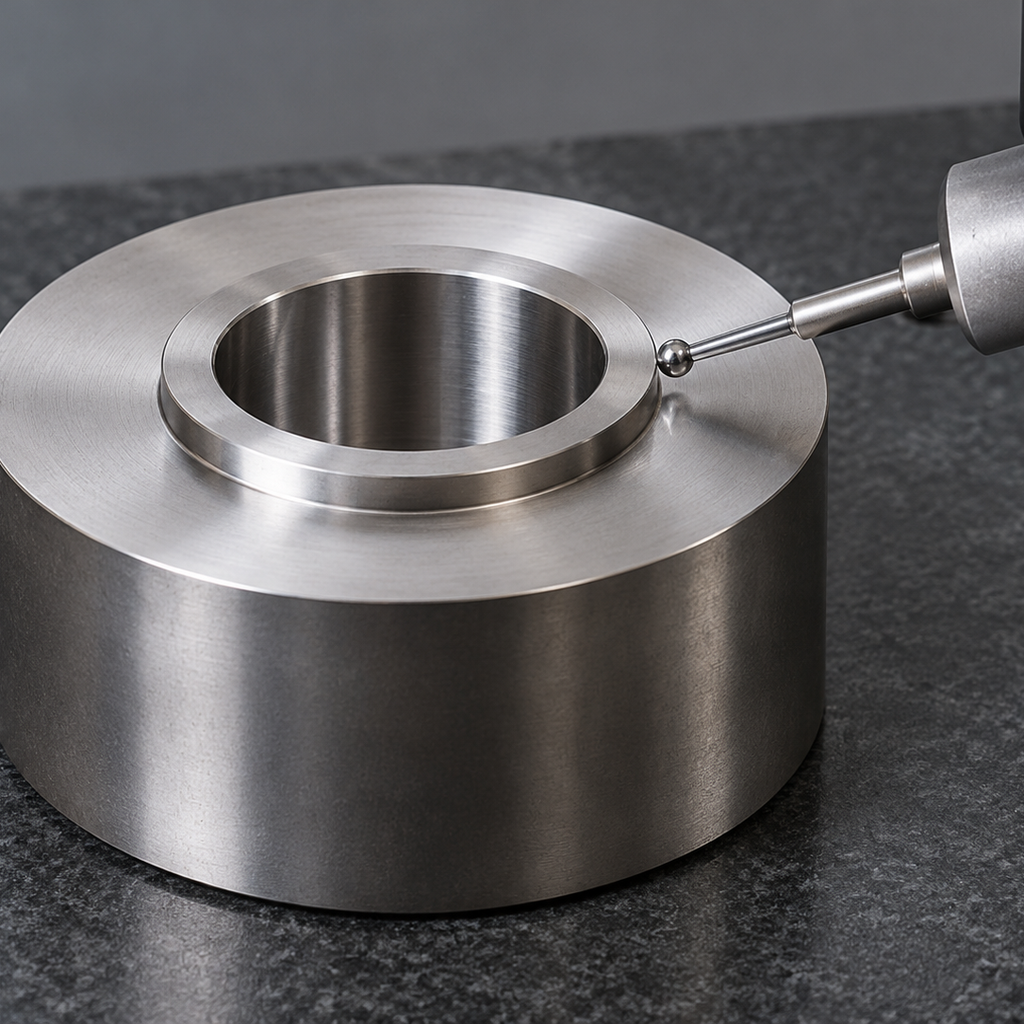
Dimensional compliance does not guarantee mass compliance because both density and volume affect mass. For small variations, the approximate relationship is Δm/m ≈ Δρ/ρ + ΔV/V.
As an illustration, a solid 50 × 40 × 28 mm block at 18.0 g/cm3 weighs 1,008 g. A ±0.05 mm tolerance on each dimension permits roughly ±4.1 g of first-order, worst-case mass variation from geometry alone, before density variation.
For tungsten alloy machining, agree blank allowance, datum sequence, edge treatment, and a designated mass-trimming area. Bore size, concentricity, and finish capability depend on the grade, geometry, and process route; every numerical tolerance requires drawing review.
Takeaway: Measure finished mass independently and trim only where the drawing explicitly permits it.
Five Steps to Specify and Qualify Custom Counterweights
Qualify the material and finished component together, using the same acceptance criteria intended for repeat orders.
- Define function: Provide target mass, envelope, center of gravity, rotational speed if applicable, attachment loads, temperature, and magnetic restrictions.
- Select the grade: Calculate minimum density, then compare binder systems and grade-specific mechanical data.
- Review manufacturability: Confirm bores, shoulders, threads, finishing allowances, and mass adjustment through our custom tungsten manufacturing capabilities.
- Agree qualification: Establish prototype quantity, inspection records, sample approval, and any independent testing before releasing repeat production.
- Confirm delivery: Record MOQ, production lead time, order-release conditions, packaging, shipping terms, and US destination.
At Tungstenmetal’s tungsten alloy manufacturing operation in Zhuzhou, China, we supply drawing-based blanks and finished components. Grade availability, achievable tolerances, MOQ, and schedule are confirmed for the specific inquiry.
Takeaway: Use prototype approval to establish a repeatable purchase specification, not just a visual sample.
Buyer FAQ: Grades, Tolerances, Orders, and Delivery
The following answers address grade selection and the commercial details needed to qualify a counterweight supplier.
Takeaway: Make grade, tolerance, documentation, and delivery commitments explicit in the quotation and order.
Request a Quote for Custom Tungsten Alloy Counterweights
FAQ
How do I choose between WNiFe and WNiCu for a custom counterweight?
Use WNiFe when strength and ductility are priorities and magnetic response is acceptable. Consider WNiCu near magnetically sensitive equipment, but specify and verify the magnetic acceptance limit. In either case, check grade-specific density and mechanical data against the available volume and mounting loads.
What mass and dimensional tolerances should I specify, and what can you manufacture?
Specify finished mass separately from dimensional requirements, including datum references, mounting fits, and permitted trim areas. Density variation can change mass even when dimensions comply. We confirm achievable numerical tolerances after reviewing your drawing, grade, geometry, and inspection requirements; the examples in this article are not capability guarantees.
What determines MOQ and lead time for prototypes and repeat orders?
MOQ depends on grade availability, blank size, setup effort, processing route, and quantity. Lead time also depends on whether new sintering is required, machining complexity, qualification testing, and the inspection scope. Request separate prototype and repeat-order quotations, and distinguish production lead time from freight transit time; no universal MOQ or delivery period applies.
Which certificates, density results, and dimensional records should I request?
Request a batch-linked material certificate identifying the grade and composition, measured density results with the method and sampling plan, finished mass records, and critical dimensional inspection results. Add mechanical-property or magnetic test reports when required, and agree whether results represent batch coupons or finished parts. A material certificate is not evidence of a company certification; confirm any required document format before ordering.
How should heavy counterweights be packaged and shipped to the United States?
Specify individually separated parts, protected bores and reference faces, and blocking or restraints that prevent dense components from shifting or striking each other. Agree carton or crate load limits and palletization for heavier consignments.
Confirm air, courier, or sea service based on shipment weight and urgency, plus Incoterms, importer responsibilities, invoice and packing-list details, and destination. If wood packaging is used, confirm applicable US import treatment and marking requirements.