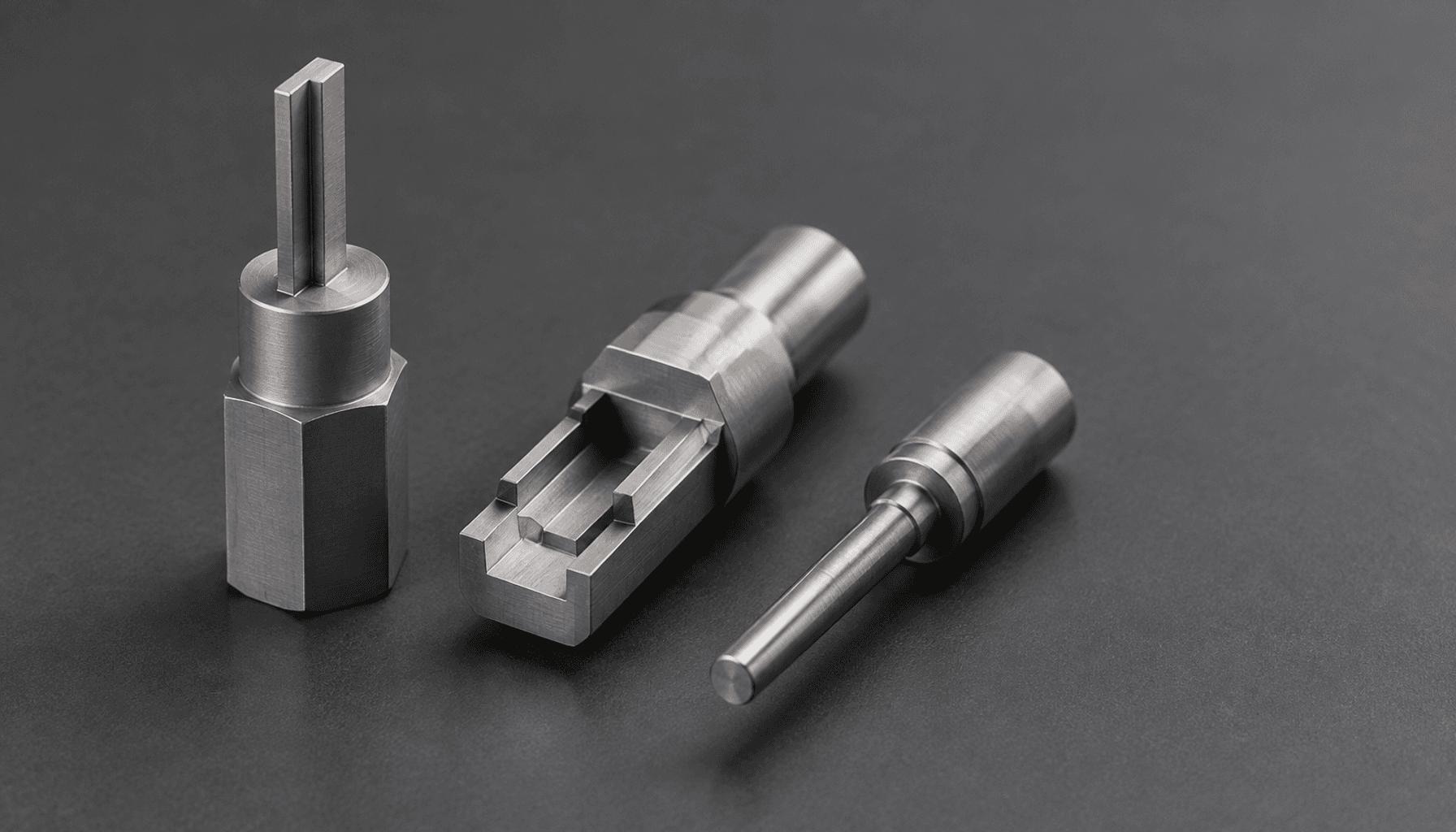
Pure Tungsten EDM Electrodes: A Custom Selection Guide
Turn a demanding mold feature into a practical electrode RFQ. Compare pure tungsten, WCu, and copper, separate electrode tolerances from spark-gap…
Table of Contents
- When to Choose Pure Tungsten EDM Electrodes
- Narrow Slots, Small Ribs, and Special-Shaped Profiles
- Comparison Table: Pure Tungsten, WCu, and Copper
- Why Workpiece Material and EDM Settings Change Electrode Wear
- Specification Summary: Material, Geometry, and Inspection
- Separate Electrode Tolerances from Spark-Gap Allowances
- Five Steps from Mold Drawing to Electrode Qualification
- Buyer FAQ: Grade, Tolerances, Orders, and Shipping
- Key Takeaways Before You Order
Choose pure tungsten EDM electrodes for narrow slots, small ribs, and detailed mold cavities when their stiffness and validated wear behavior justify the cost of making the electrode. Start with the mold feature, then specify the workpiece, discharge conditions, electrode geometry, and inspection requirements before requesting a quote.
When to Choose Pure Tungsten EDM Electrodes
Choose pure tungsten when a thin working profile needs high stiffness and a trial demonstrates acceptable edge retention, machining stability, and total cost. It is not automatically the best choice for large cavities or general roughing, where copper or tungsten copper may be more economical.
Pure tungsten has a typical room-temperature density—mass per unit volume—of approximately 19.25 g/cm3 and a melting point of approximately 3422 °C. These properties identify the material, but melting point alone does not predict electrode wear or cavity finish.
Takeaway: Select around the mold feature and verified EDM behavior, not a single material property.
Narrow Slots, Small Ribs, and Special-Shaped Profiles
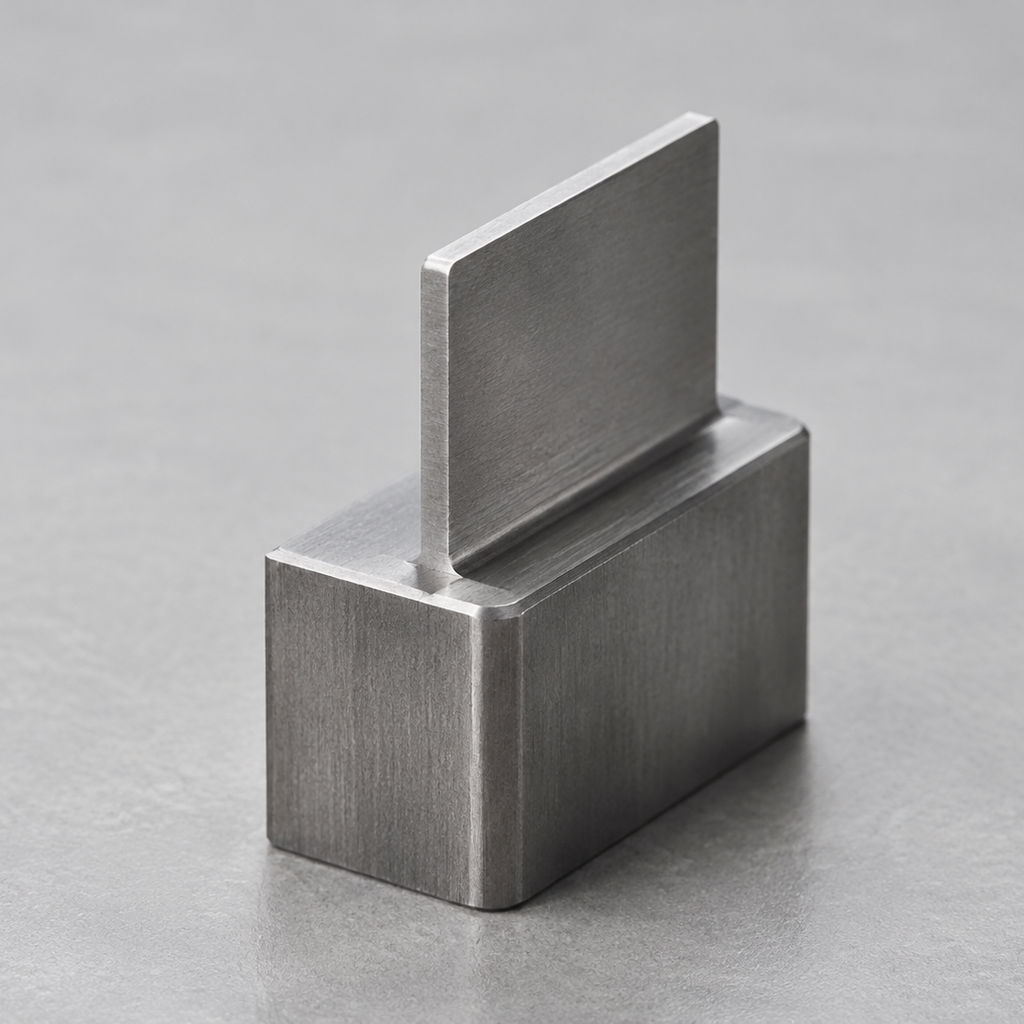
Thin ribs and deep, narrow slots are candidates because electrode deflection and edge damage can affect feature accuracy. Tungsten is stiff, but slender profiles remain vulnerable to chipping during manufacture, clamping, cleaning, and transport.
For custom pure tungsten EDM electrodes, identify minimum rib thickness, unsupported height, corner radii, mounting datums, and flushing access. A profile that can be manufactured may still be difficult to flush reliably at full cavity depth.
Takeaway: Review the working profile, support geometry, and debris-removal path together.
Comparison Table: Pure Tungsten, WCu, and Copper
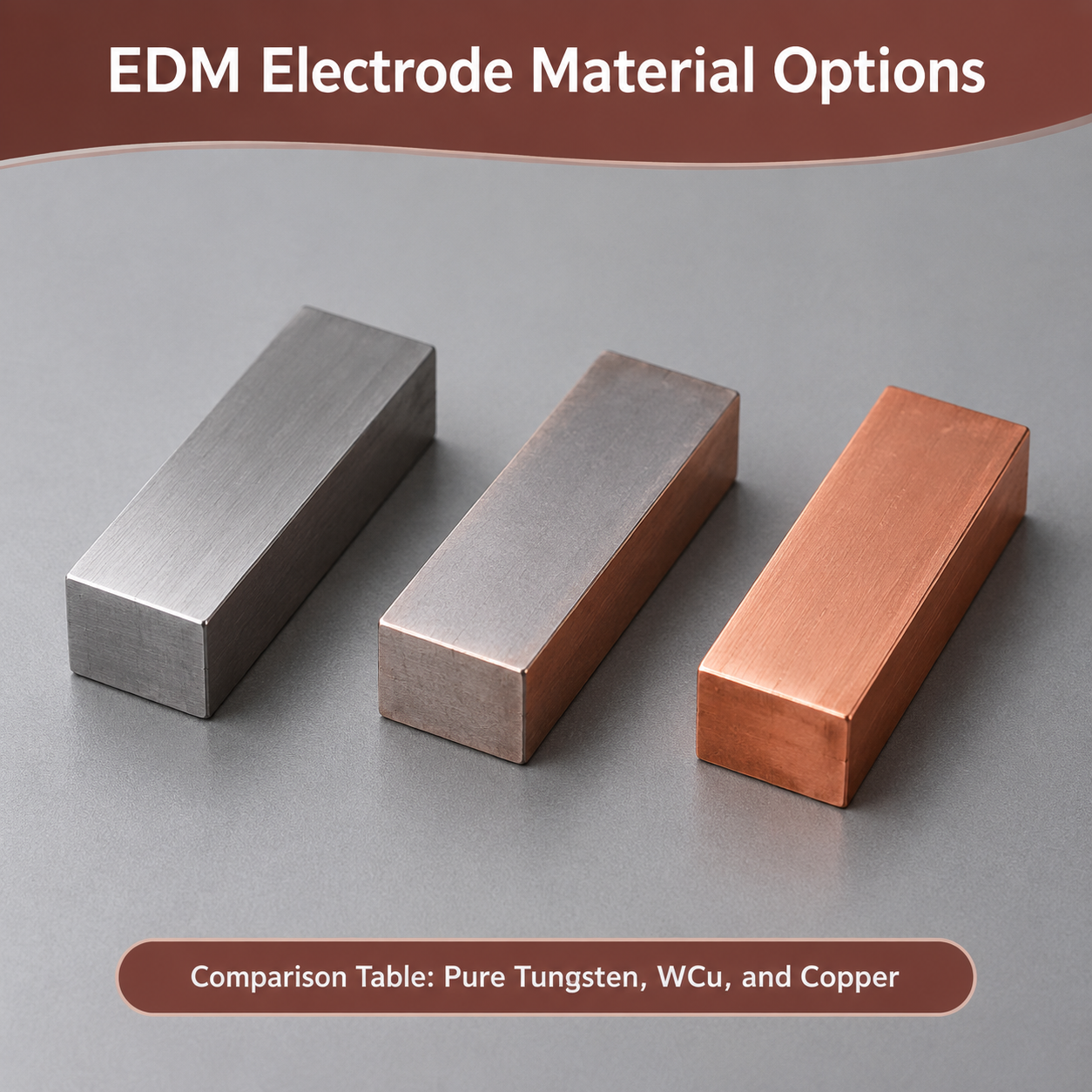
The practical tungsten vs copper tungsten electrodes decision balances profile stability, conductivity, manufacturability, and measured wear. WCu means tungsten copper: a composite commonly produced by infiltrating a sintered porous tungsten skeleton with copper; sintering bonds powder particles through heating.
| Material | Composition and density | Useful characteristics | Selection limitations |
|---|---|---|---|
| Pure tungsten | Commercially pure W; approximately 19.25 g/cm3 | High stiffness; candidate for small, slender working profiles | Demanding profile manufacturing; brittle edges; wear requires validation |
| WCu | Examples: 70W/30Cu, 80W/20Cu, 90W/10Cu by weight; approximately 14.1–17.0 g/cm3 | Combines a refractory tungsten framework with conductive copper | Composition and porosity affect properties; grades are not interchangeable |
| Copper | High-conductivity copper grade; approximately 8.96 g/cm3 | High electrical and thermal conductivity; generally easier to machine | Lower stiffness; thin profiles can deform or develop burrs during manufacture |
Values are approximate room-temperature references, not acceptance limits. Pure tungsten melts near 3422 °C and copper near 1085 °C; WCu has no single melting point because its constituents behave differently.
Specify the composition when evaluating tungsten copper alloy electrodes, rather than ordering only “copper tungsten.”
Takeaway: Compare complete electrode-making and EDM costs; do not assume tungsten always gives lower wear or better finish.
Why Workpiece Material and EDM Settings Change Electrode Wear
Electrode wear depends on the electrode–workpiece pair and the discharge process, not melting point alone. Tool steel and cemented carbide can require different settings, and changing polarity, pulse duration, current, or dielectric conditions can change relative material performance.
Record workpiece grade and hardness, machine model, polarity, roughing and finishing settings, dielectric, flushing method, and orbital motion. Inadequate debris removal can cause unstable discharges and localized damage, especially in deep slots.
During trials, measure end wear, side wear, and corner rounding separately; an overall wear figure can conceal loss of a critical edge.
Takeaway: Qualify die-sinking EDM electrodes under representative production conditions.
Specification Summary: Material, Geometry, and Inspection
Specify the supplied electrode, not only the finished cavity. Provide a revision-controlled drawing and a 3D model where helpful, clearly distinguishing blank dimensions from finished working surfaces.
| RFQ item | What to specify | Acceptance evidence |
|---|---|---|
| Material | Pure W; required purity, such as ≥99.95 wt% if needed, subject to confirmation | Agreed batch material certificate and chemistry information |
| Supply form | Blank, semi-finished electrode, or finished profile | Drawing revision and clearly identified finished surfaces |
| Working geometry | Rib thickness, height, radii, taper, profile position, surface finish | Dimensional report for agreed characteristics |
| Mounting interface | Shank dimensions, datum surfaces, alignment requirements | Inspection against the specified datums |
| Traceability | Part number, revision, batch identification, document requirements | Matching package labels and inspection records |
Purity is a purchase requirement to agree, not a blanket claim for every available blank. Review drawing-based tungsten manufacturing capabilities before fixing detailed acceptance criteria.
Takeaway: Make material identity, finished geometry, and verification methods explicit.
Separate Electrode Tolerances from Spark-Gap Allowances
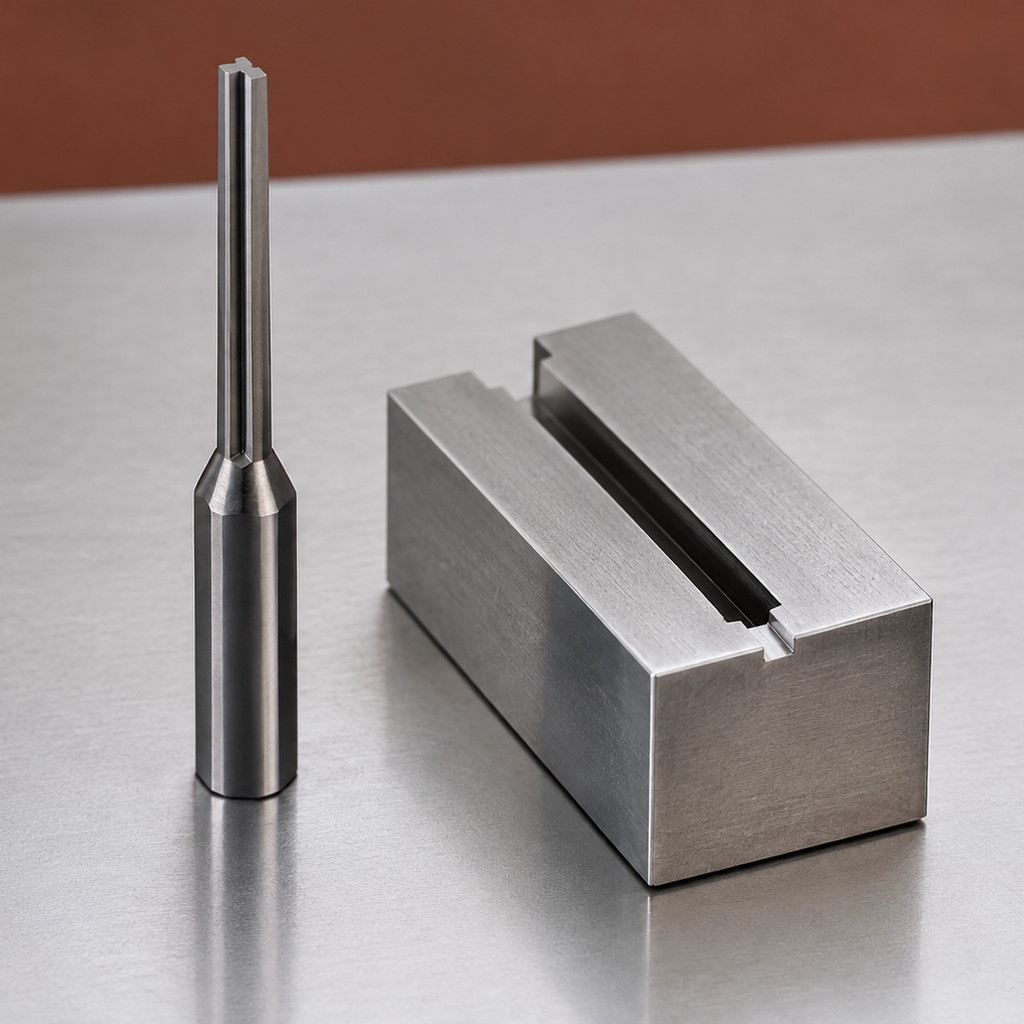
EDM electrode tolerances control the manufactured electrode. Spark-gap compensation offsets its nominal geometry for the discharge gap, while finished-cavity accuracy also depends on wear, alignment, machine behavior, and temperature.
For a simple straight slot, assume a target width of 0.500 mm and an illustrative side gap of 0.010 mm per side. The corresponding rib starts at 0.480 mm before additional wear or orbital-motion corrections; this is a calculation example, not a recommended machine setting.
A drawing could separately request 0.480 ±0.005 mm rib thickness, but that tolerance remains subject to manufacturing and inspection review. State whether supplied CAD is already compensated, who owns compensation, and how fragile profiles will be measured without distortion.
Takeaway: Never treat electrode tolerance, gap allowance, and cavity tolerance as interchangeable.
Five Steps from Mold Drawing to Electrode Qualification
Use a drawing review followed by a controlled trial before approving repeat production of custom tungsten electrodes.
- Define the cavity: Supply workpiece grade, hardness, feature dimensions, depth, corner requirements, and target surface finish.
- Define the electrode: Identify material, mounting datums, working profile, roughing or finishing duty, and compensation responsibility.
- Review manufacturability: Agree achievable tolerances, inspection access, trial quantity, documentation, packaging, and delivery assumptions.
- Run a representative trial: Record settings, machining time, flushing stability, electrode wear, cavity dimensions, and finish.
- Release the repeat specification: Freeze the electrode revision and approved process, retaining trial results and batch identification.
Agree required dimensional records through the tungsten component quality control review before production, rather than requesting extra measurements after shipment.
Takeaway: Qualify both the supplied part and the EDM process; neither proves the other automatically.
Buyer FAQ: Grade, Tolerances, Orders, and Shipping
Grade, tolerance capability, minimum order quantity, and delivery must be confirmed against your drawing. The buyer questions below identify the commercial and inspection details to settle before ordering.
Takeaway: Use the quotation and approved drawing as the acceptance baseline, not generic product descriptions.
Key Takeaways Before You Order
- Choose the electrode material around the mold feature and verified EDM conditions.
- Separate material requirements, electrode tolerances, and spark-gap compensation.
- Agree trial acceptance, inspection records, and profile-protecting packaging before production.
The most useful RFQ combines your cavity drawing with the proposed electrode geometry and process information. Tungstenmetal technical resources support initial selection; drawing review and a representative trial establish the production specification.
FAQ
Which grade should I choose: pure tungsten, WCu, or copper?
Consider pure tungsten for slender, detailed profiles where stiffness matters and trials support its use. Evaluate WCu when its combined conductivity and refractory framework suit the operation, and copper when machinability and cost favor it. Specify tungsten purity or WCu composition explicitly; no material guarantees the lowest wear across all EDM conditions.
Which electrode dimensions and tolerances should I specify?
Specify working-profile dimensions, rib thickness and height, radii, taper, surface finish, mounting datums, and position requirements. Identify whether the model already includes spark-gap compensation. We review the geometry and measurement method before confirming tolerances; electrode accuracy alone does not guarantee finished-cavity accuracy.
What determines MOQ and lead time for custom electrodes?
Minimum order quantity (MOQ) and lead time depend on blank availability, profile complexity, setup and finishing requirements, quantity, inspection, and packaging. State your desired trial quantity and required arrival date. We confirm the order quantity and production schedule after drawing review; shipping and customs time should be considered separately.
Which certificates and inspection records should accompany the electrodes?
Request an agreed batch material certificate identifying the material and relevant chemistry, plus a dimensional report tied to your part number and drawing revision. Specify critical features, measurement methods, and batch traceability. Confirm document availability and any third-party inspection requirements before ordering; a material certificate is not a claim of management-system certification.
How should fragile profiles be packaged and shipped to a US mold shop?
Require individual retention at robust mounting or shank surfaces, with clearance around working ribs and no loose-part contact. Use a rigid inner container, protective cushioning, and a suitable outer carton or crate for shipment weight. Agree identification labels, packing list, commercial invoice, shipping terms, destination ZIP code, and responsibility for import clearance before dispatch.