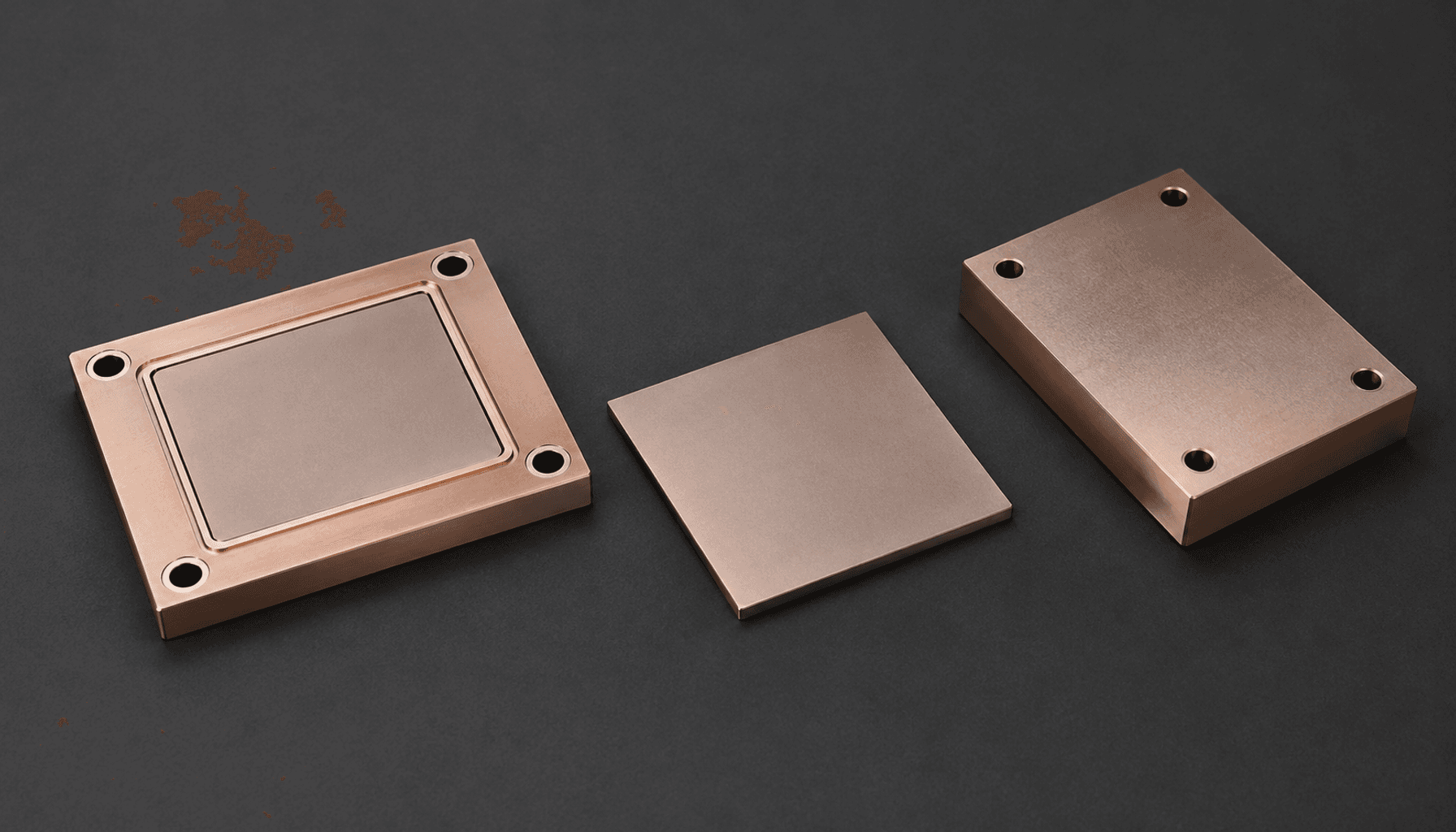
WCu Heat Sink: Composition, CTE, and Drawing Requirements
Compare nominal WCu compositions and translate thermal, mechanical, and interface requirements into a drawing-based RFQ for electronic packaging bases and…
Table of Contents
- When Should You Specify a WCu Heat Sink?
- Compare WCu Compositions for Electronic Packaging
- Specify a Finished Part That Fits the Thermal Assembly
- Five Steps to Prepare a Custom WCu Heat Sink RFQ
- Buyer FAQ: Grades, Tolerances, Qualification, and Shipping
A WCu heat sink is useful when an electronic package needs heat conduction combined with lower thermal expansion than copper alone provides. Choose its tungsten-to-copper ratio for the complete assembly, then specify the contact geometry, joining conditions, and inspection requirements needed to make that material choice work.
When Should You Specify a WCu Heat Sink?
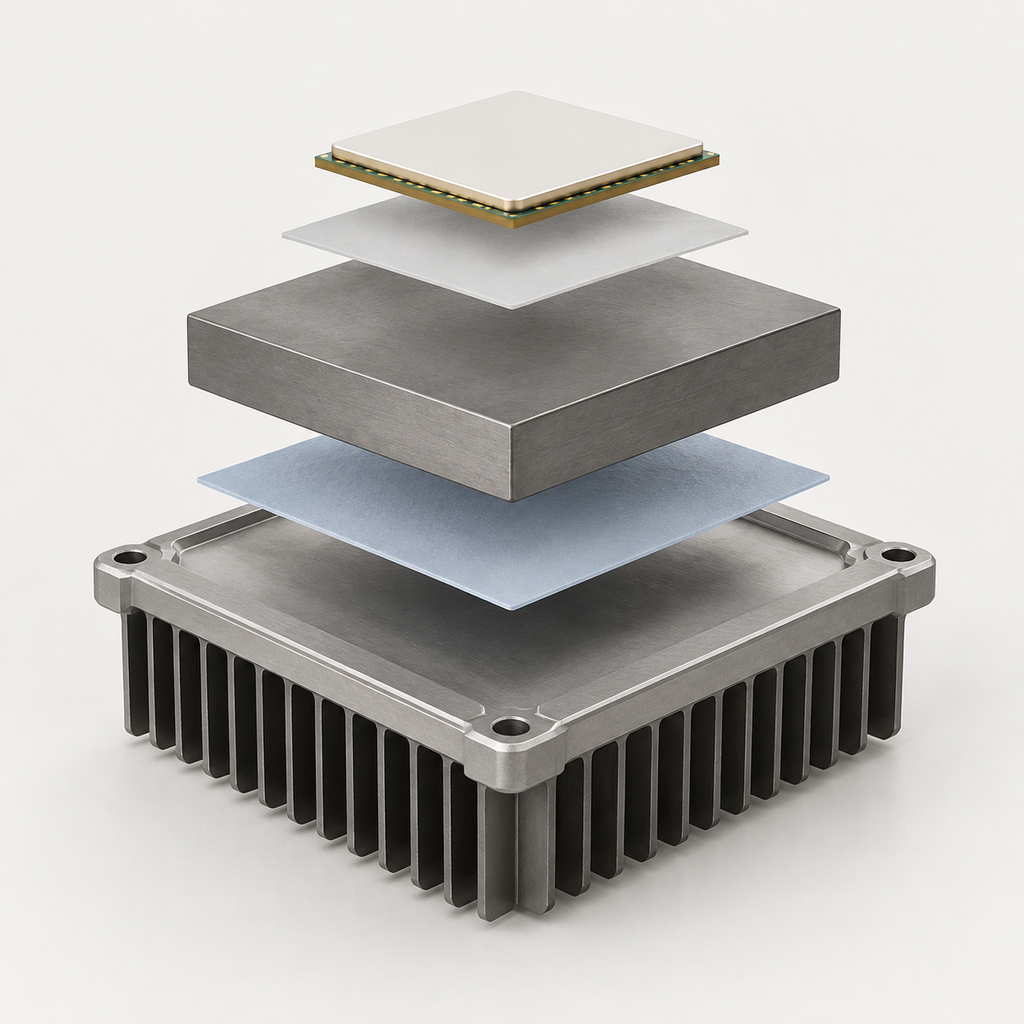
Specify WCu when copper’s expansion would create unacceptable package stress, but you still need a conductive path beneath an RF device or power module. A tungsten copper heat spreader distributes heat through the package base; it does not replace the cold plate, finned cooler, or other system that ultimately rejects heat.
Direct answer: balance heat conduction with package expansion requirements
More tungsten generally reduces expansion, while more copper generally improves thermal conductivity. Select the composition against allowable junction temperature, substrate expansion, joining temperature, and thermal-cycle loading—not conductivity alone. Our WCu electronic packaging components address this package-level application.
Define thermal conductivity, CTE, and the role of a heat spreader
- Thermal conductivity, k
- A material’s ability to conduct heat, expressed in W/(m·K).
- Coefficient of thermal expansion, CTE
- Fractional dimensional change per degree of temperature change, commonly expressed in ppm/K. Mean CTE must identify its temperature interval.
- Density
- Mass per unit volume, expressed here in g/cm³.
For ideal one-dimensional conduction, thermal resistance is R = t/(kA), where t is thickness and A is conducting area. Actual packages also have spreading resistance and interface resistance.
Practical takeaway: Evaluate WCu as one layer in the complete thermal and mechanical stack.
Compare WCu Compositions for Electronic Packaging

Use 75W/25Cu, 80W/20Cu, and 85W/15Cu as candidate compositions, not interchangeable grades. These designations identify nominal weight percentages, not guaranteed thermal properties.
Comparison table: 75W/25Cu, 80W/20Cu, and 85W/15Cu by weight
| Nominal composition | Calculated fully dense density | Relative conductivity tendency | Relative CTE tendency | Selection emphasis |
|---|---|---|---|---|
| 75W/25Cu | 14.5 g/cm³ | Higher among these candidates | Higher among these candidates | Heat conduction where greater expansion is acceptable |
| 80W/20Cu | 15.2 g/cm³ | Intermediate | Intermediate | Starting point for a balanced assembly review |
| 85W/15Cu | 16.0 g/cm³ | Lower among these candidates | Lower among these candidates | Expansion control where thermal resistance remains acceptable |
Density estimates use ρ = 1/(wW/ρW + wCu/ρCu), with constituent densities of approximately 19.25 and 8.96 g/cm³. They assume no porosity and are not delivered-density acceptance limits.
Verified grade-specific conductivity and CTE measurements were not supplied for this guide. Therefore, no numerical thermal-property guarantees are assigned to these compositions. Request conductivity in W/(m·K) at your design temperature and mean CTE in ppm/K over an explicitly stated interval, such as 20–200 °C if that interval suits your assembly.
Tungsten copper alloy materials are commonly produced through powder-metallurgy routes involving a tungsten skeleton and copper infiltration. Residual porosity, composition, and processing condition influence delivered properties.
Why CTE compatibility depends on temperature, geometry, and the joining layer
For a simple unconstrained estimate, differential movement is ΔL ≈ L × Δα × ΔT. If two materials differ by 3 ppm/K across 20 mm and a 150 K excursion, their free differential movement is about 9 μm; this is an illustration, not a grade prediction.
Bond thickness, joint compliance, substrate stiffness, and temperature gradients determine how that movement becomes stress or warpage. WCu thermal expansion must therefore be evaluated through joining cooldown and operation, not only near room temperature.
Practical takeaway: Shortlist compositions by trend, then qualify numerical properties and assembly behavior.
Specify a Finished Part That Fits the Thermal Assembly
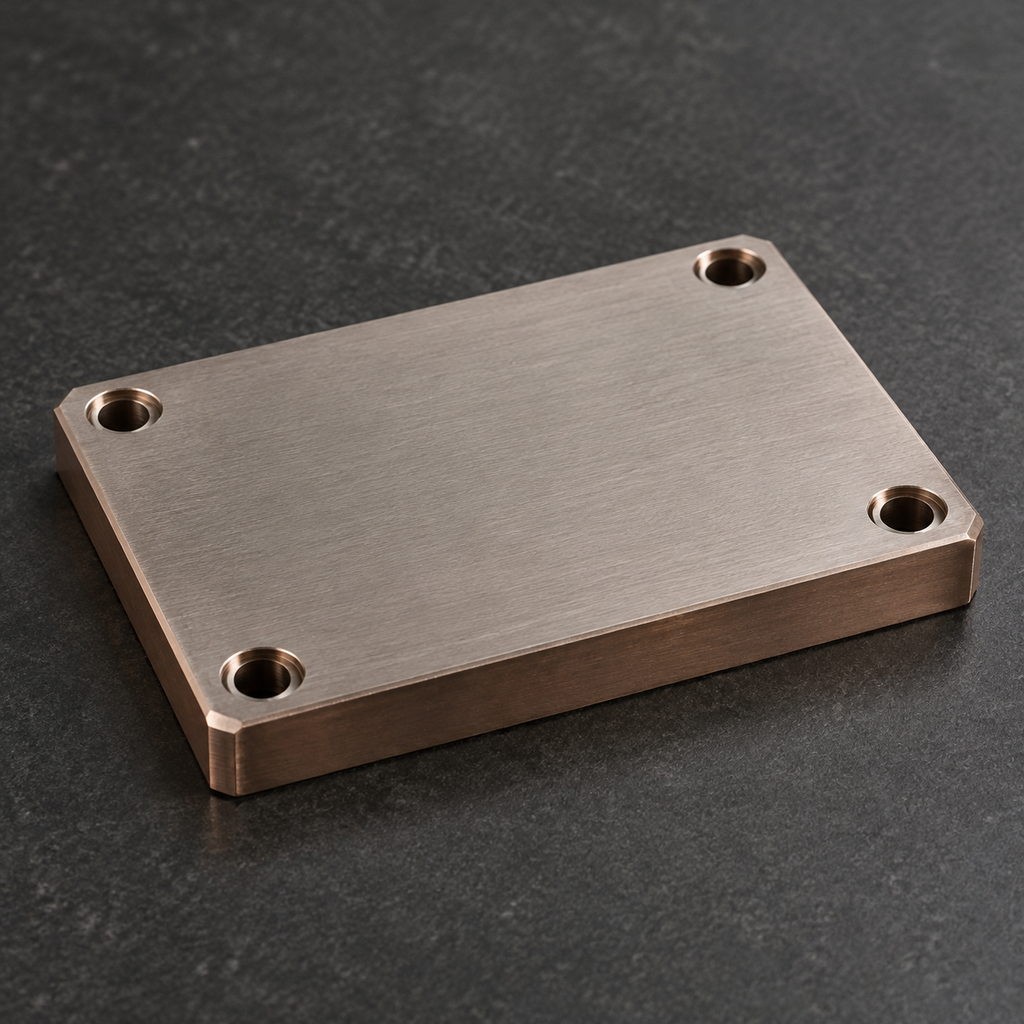
Specify tolerances from interface function, then confirm achievable values through drawing review. There is no universal flatness or thickness tolerance for every electronic packaging heat sink.
Thickness, mounting features, flatness, parallelism, and surface finish
Thickness affects conduction distance, stiffness, and assembly height. Identify mounting-hole position, thread details if required, edge clearances, chamfers, and the contact area that must remain free of damage.
Flatness controls individual surface form; parallelism controls orientation relative to a datum; roughness describes smaller-scale surface texture. A low Ra value does not prove flatness. Define whether inspection is free-state or restrained, and whether requirements apply before or after joining.
Specification summary: composition, conductivity, CTE, and inspection conditions
| Drawing or purchase-order item | Required definition |
|---|---|
| Material | Nominal W/Cu weight percentages, composition limits, and material condition |
| Thermal conductivity | Required value in W/(m·K), temperature, method, and evidence required |
| CTE | Allowable ppm/K, temperature interval, and measurement direction where relevant |
| Density | Agreed g/cm³ acceptance range and inspection method |
| Geometry | Thickness tolerance, datums, contact-area flatness, parallelism, and mounting features |
| Surface condition | Ra limit, cleanliness, edge condition, and any separately reviewed coating requirement |
| Inspection | Measurement temperature, support condition, sampling, and report format |
If you propose 0.02 mm flatness or Ra 0.8 μm, identify the controlled area and treat those numbers as requested requirements—not published capability. Part size, thickness, stock condition, and inspection setup determine feasibility. Review these details against our drawing-based custom manufacturing capabilities.
Practical takeaway: Control the functional contact surfaces explicitly rather than applying unnecessarily tight tolerances everywhere.
Five Steps to Prepare a Custom WCu Heat Sink RFQ
A useful RFQ links material requirements to assembly conditions and acceptance evidence. When evaluating a custom WCu heat sink manufacturer, resolve these five items before comparing quotations.
- Describe the thermal stack. Identify substrate material, heat-source footprint, heat load, cooling arrangement, operating range, and joining process.
- Define candidate material. State composition if known and separate desired conductivity and CTE from mandatory acceptance limits.
- Submit controlled geometry. Provide a revision-controlled drawing and, where available, a 3D model or sample. Mark datums and critical contact surfaces.
- Agree on qualification evidence. Request batch identity, composition records, material certificates, and dimensional reports. Separately quote additional thermal testing, methods, sampling, and acceptance criteria.
- Define purchasing and delivery. State prototype and production quantities, required date, packaging restrictions, US delivery address, and preferred shipping terms.
At Tungstenmetal custom tungsten manufacturing, we use drawing-based requirements to review the material and finished-part scope. Grade selection does not by itself establish delivery timing or qualification status.
Practical takeaway: Compare quotations against the same drawing revision, test scope, quantity, and delivery terms.
Buyer FAQ: Grades, Tolerances, Qualification, and Shipping
The answers below identify what must be confirmed before ordering, including batch records and contact-surface protection. Our material and dimensional quality control information provides context for agreeing on inspection deliverables.
Practical takeaway: Put the agreed grade, geometry, evidence, and packaging requirements into the purchase order.
FAQ
How do I choose a WCu composition for an RF package or power module?
Compare candidate compositions against both thermal resistance and expansion-related stress. More copper generally favors conductivity; more tungsten generally lowers CTE. Confirm grade-specific conductivity at the relevant temperature and CTE over the joining and operating intervals, then evaluate the assembled package.
Which thickness, flatness, parallelism, and surface-finish tolerances should I specify?
Specify limits derived from stack height, bond-line thickness, contact area, and mounting design. Identify datums, measurement area, inspection temperature, and free-state or restrained conditions. Achievable values require review of the actual drawing; no universal numerical capability is stated here.
What MOQ applies, and can I order prototypes or qualification parts?
No fixed MOQ or prototype-order commitment is established in this guide. Provide trial quantity and expected production volume so we can confirm feasibility, minimum batch requirements, and pricing for your composition and geometry.
What affects lead time, and which certificates or batch records should I request?
Lead time depends on material availability, geometry, finishing, quantity, inspection, and any additional testing. Request batch identification, composition records, an agreed material certificate, and dimensional results. Confirm whether thermal values are reference data or measured results; thermal testing and third-party inspection require prior agreement. No certification is implied.
How should contact surfaces be protected for shipping to the United States?
Specify individual separation, clean nonabrasive contact protection, immobilization, and moisture protection appropriate to the route. Any film or preservative must be compatible with later joining and cleanliness requirements. Provide the US delivery address and ZIP code, consignee details, shipping terms, and carrier or broker requirements so the packaging and freight plan can be confirmed.