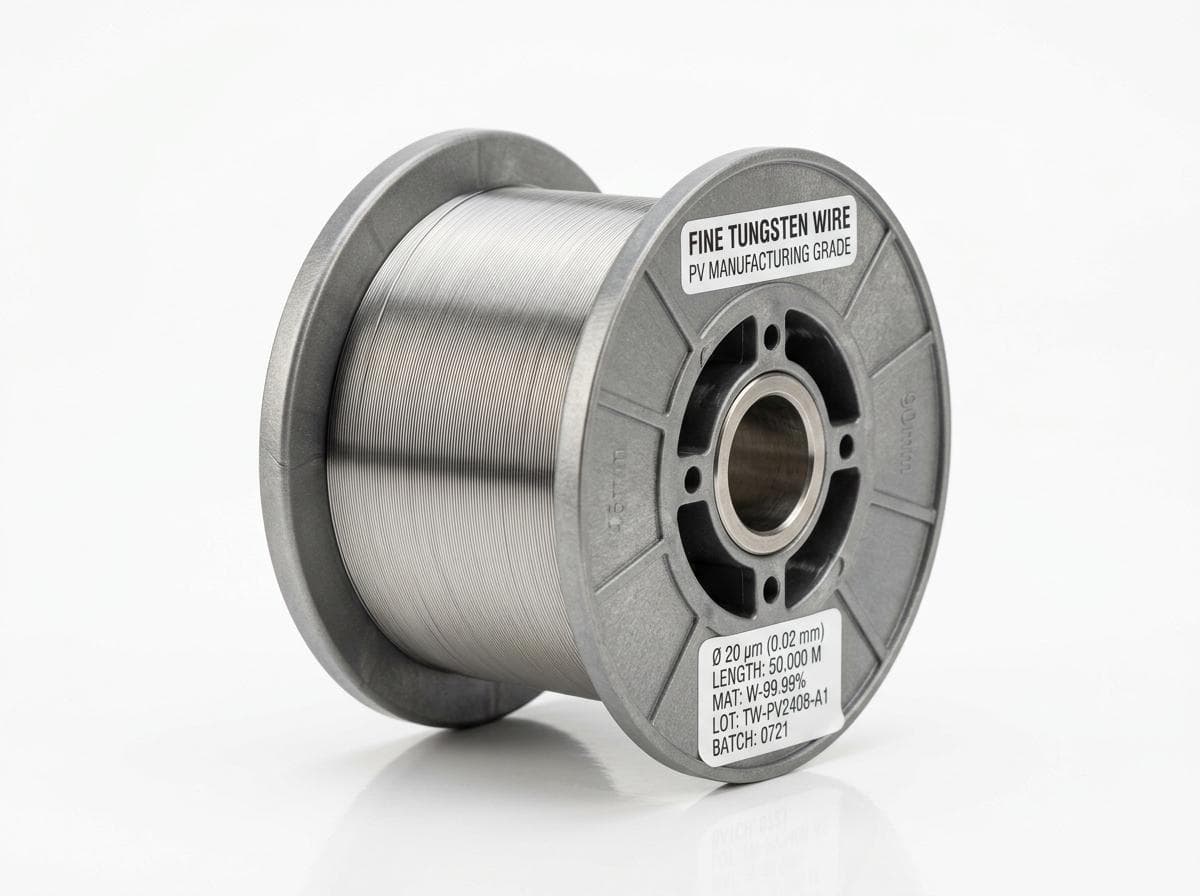
Tungsten Wire for Photovoltaic Slicing: Diameters, Purity, and Buyer Checklist
How diameter, purity grade, and batch consistency affect photovoltaic tungsten wire for diamond-wire wafer slicing — with a practical RFQ checklist.
Why tungsten wire is used for wafer slicing
Photovoltaic wafer slicing has moved decisively toward diamond wire sawing (DWS), and the mother wire onto which the diamond abrasive is electroplated is increasingly drawn from high-purity tungsten in place of steel cores. Tungsten carries higher tensile strength at equal or smaller diameter, which lets the wire survive the tension and abrasion of high-speed slicing loops while enabling thinner wafers.
For slicing-line operators, the wire is a consumable whose consistency directly drives kerf loss, breakage rate, and wafer surface quality. That is why diameter control and batch uniformity matter more than any single headline specification.
Diameters and what they change
Common promoted diameters for PV mother wire sit in the fine range — for example 0.035 mm, 0.037 mm, 0.10 mm, and 0.11 mm. As diameter decreases, less silicon is removed per cut (lower kerf loss) and more wafers per ingot, but wire tension management and breakage risk become more demanding.
- Finer wire: lower kerf loss and higher ingot yield, but stricter tension and guide-wheel control
- Coarser wire: higher cutting robustness for thicker or more abrasive material
- Diameter tolerance: tighter tolerance reduces vibration marks and stabilizes wire-saw operation
Purity grades: W1 and W2
Chinese tungsten wire grades are commonly referenced as W1 (≥ 99.95% W) and W2 (≥ 99.92% W). For PV slicing, buyers typically specify the higher-purity grade to limit inclusions that can initiate wire breaks, and to stabilize drawing and annealing behavior through the spool.
Purity interacts with surface finish: a clean, uniform surface reduces friction in the slicing loop and supports more consistent diamond coating adhesion for coated-wire processes.
Buyer checklist for PV tungsten wire RFQs
When requesting quotation, the details that shorten technical review are the same ones that predict slicing performance:
- Target diameter and tolerance band (e.g., 0.035 mm ± tolerance)
- Purity grade: W1 ≥ 99.95% or W2 ≥ 99.92%
- Spool dimensions, winding pattern, and length per spool
- Tensile strength or breaking-force requirement at the target diameter
- Monthly or annual consumption estimate for lot-consistency planning
- Destination market and any incoming-inspection standard to align
Summary
Photovoltaic tungsten wire is specified by diameter consistency, purity grade, and spool-level uniformity. Buyers who fix these three variables early — and share consumption volume — get quotations that translate into stable slicing-line performance.