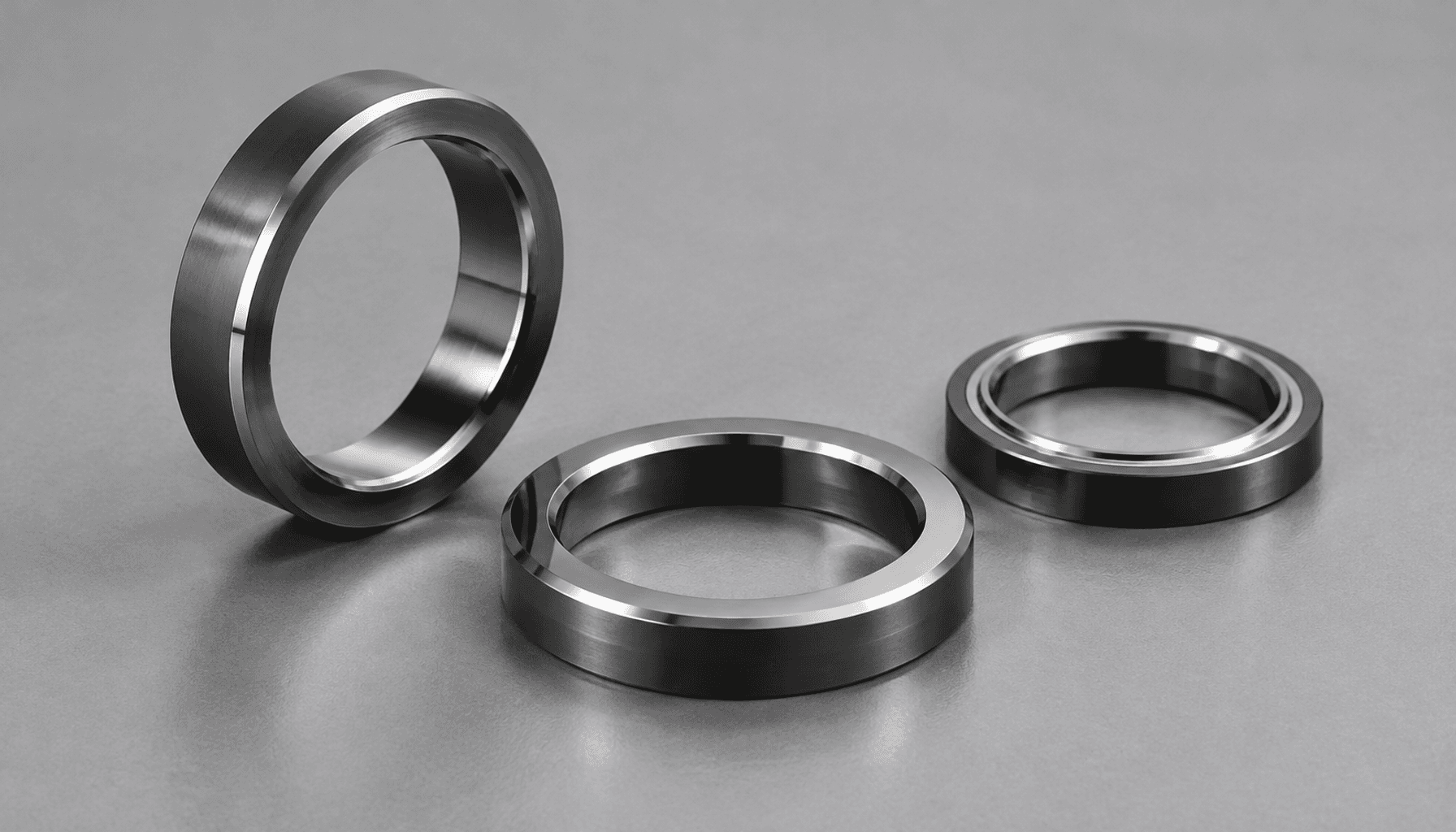
Tungsten Carbide Seal Rings: Grade and Tolerance Guide
A drawing-review guide for specifying carbide seal rings, comparing binder options, separating flatness from roughness, and preparing an RFQ with clear inspection and delivery requirements.
Table of Contents
- How to Specify Tungsten Carbide Seal Rings
- Compare Seal Materials and Carbide Grade Variables
- Define Dimensions, Face Flatness, and Surface Finish
- Five Steps from Service Conditions to an RFQ
- Buyer FAQ: Grades, Tolerances, Orders, and Delivery
- Request a Quote for Custom Tungsten Carbide Seal Rings
Specify tungsten carbide seal rings by matching binder chemistry and carbide grain size to the fluid, abrasive loading, and mating face, then defining sealing-face geometry separately from mounting dimensions. Wear resistance alone does not predict leakage or service life: lubrication, face loading, thermal distortion, and assembly design also govern performance.
How to Specify Tungsten Carbide Seal Rings
Start with the operating envelope, not a hardness target. Record fluid composition, solids concentration and particle size, temperature, pressure differential, shaft speed, and startup or dry-running exposure.
Definition: Cemented tungsten carbide consists of hard tungsten carbide (WC) grains held together by a metallic binder, commonly cobalt or nickel, consolidated by sintering. A mechanical seal ring provides one of the precision annular faces that control leakage between rotating and stationary components.
Takeaway: Specify the ring as part of a sealing system, not simply as a hard wear component.
Direct answer: match the material and face specification to the sealing conditions
For abrasive service, evaluate WC grain size and binder fraction together. For corrosive service, first check whether the fluid attacks the binder; increasing hardness will not prevent binder dissolution and subsequent grain pullout.
Identify the counterface—carbon, silicon carbide, or another carbide grade—and whether the pair operates with a stable liquid film. Include mounting interference and housing material because assembly stress and differential thermal expansion can distort a previously flat face.
Drawing-review priority: Establish chemical compatibility and the face pairing before tightening dimensional tolerances.
Compare Seal Materials and Carbide Grade Variables
The best mechanical seal ring materials depend on both chemical compatibility and mechanical loading. WC-Co, nickel-bonded carbide, and silicon carbide are not interchangeable merely because all resist abrasion.
Takeaway: Compare complete grade specifications and service conditions rather than selecting by material name alone.
Define WC grain size, binder content, and Rockwell A hardness
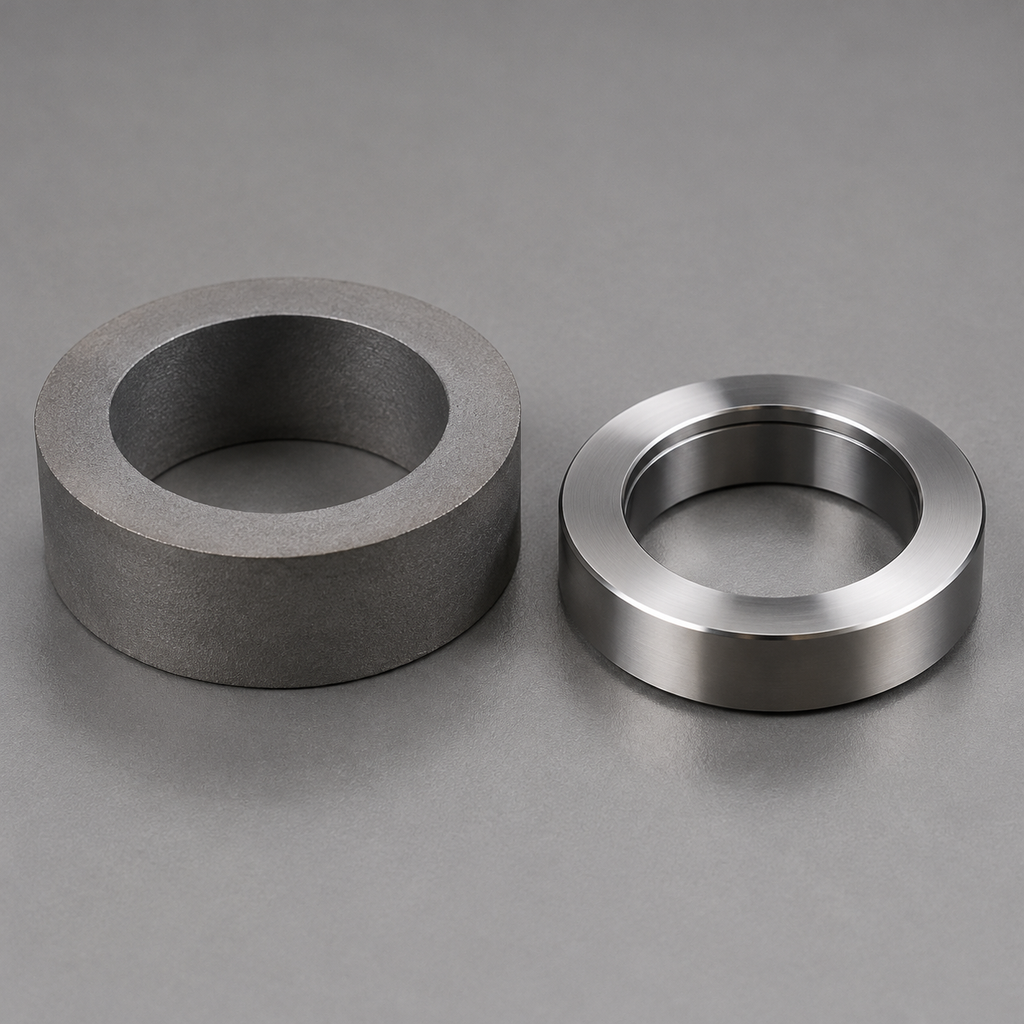
WC grain size describes the carbide microstructure, normally reported in micrometers (µm), not the ring’s surface texture. Binder content is the metallic phase’s percentage by mass; WC–6Co, for example, denotes nominally 6 wt% cobalt and 94 wt% WC.
HRA means Rockwell A hardness, an indentation-hardness scale. Conventional fine-to-medium WC-Co grades with approximately 6–10 wt% cobalt commonly fall around 89–92 HRA; these are screening references, not verified specifications for a particular supplied grade.
At comparable binder content, finer WC often improves hardness and abrasion resistance. More binder generally improves toughness but reduces hardness; corrosion resistance also depends on binder composition and processing.
Takeaway: Require the proposed grade’s verified datasheet values for binder percentage, grain size, and hardness before approval.
Comparison table: WC-Co, nickel-bonded carbide, and silicon carbide
| Material | Reason to evaluate | Selection limitation |
|---|---|---|
| WC-Co: cobalt-bonded tungsten carbide | Abrasion resistance with useful toughness under mechanical loading | Some acidic or chemically aggressive fluids attack cobalt; verify actual chemistry and temperature. |
| WC-Ni: nickel-bonded tungsten carbide | An alternative where nickel binder offers better compatibility than cobalt | Not universally corrosion-proof; verify the exact binder alloy, fluid concentration, and grade properties. |
| SiC: silicon carbide | Hard ceramic option for many abrasive and corrosive fluids | Generally less tolerant of impact and assembly damage than cemented carbide. Reaction-bonded and sintered grades differ chemically. |
Nobody should approve a face pair from this table alone. Lubrication, heat removal, thermal shock, and contact loading require evaluation at assembly level.
Takeaway: Use chemistry to narrow the material family, then evaluate wear and mechanical reliability.
Define Dimensions, Face Flatness, and Surface Finish
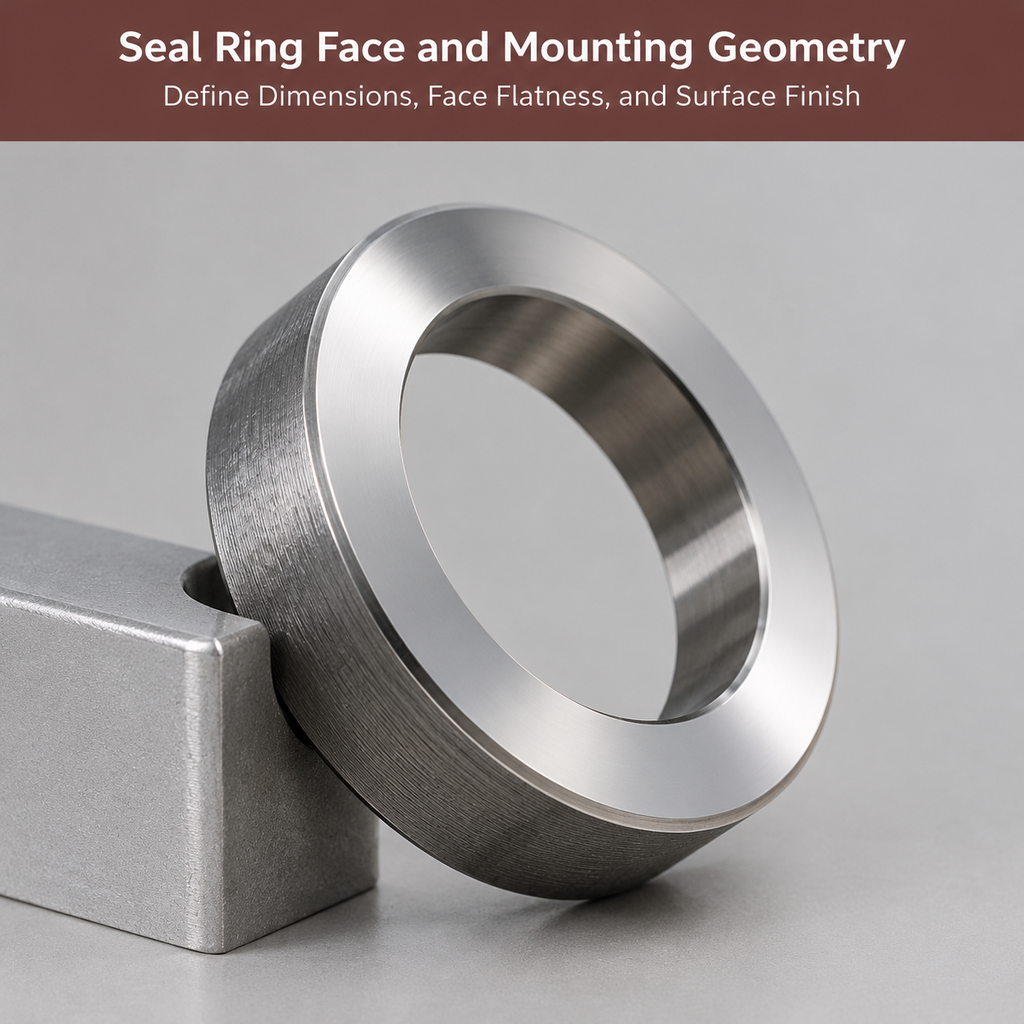
Your drawing should distinguish the functional sealing annulus from the bore, outside diameter, shoulders, and locating surfaces. Specify dimensional units explicitly and identify which surfaces locate the ring in its holder.
Carbide seal ring flatness is not established by a polished appearance. Also define whether face inspection occurs before mounting or after assembly, when interference and clamping can change the result.
Takeaway: Tie each requirement to the surface and assembly condition that matter in service.
Separate flatness, parallelism, runout, and roughness requirements
- Flatness: the form of one face between two parallel planes; it does not reference a datum.
- Parallelism: the orientation of a surface relative to a datum plane.
- Runout: variation measured during rotation about a datum axis; specify circular or total runout as appropriate.
- Roughness: small-scale surface texture. Ra is the arithmetic mean profile deviation measured under defined filtering and evaluation conditions.
Specify sealing-face roughness separately from ground sidewalls. Edge chips, scratches, pits, and waviness may also require acceptance criteria; a low Ra value alone does not exclude them.
Takeaway: A flat face can be tilted relative to its mounting shoulder, and a smooth face can still be out of flat.
Specification summary: grade, dimensions, units, datums, and inspection methods
The numerical examples below illustrate drawing notation, not recommended limits for every seal or manufacturing capability guarantees. Approve grade values against verified material data and dimensional requirements through drawing review.
| Item | Information to specify | Verification |
|---|---|---|
| Binder | Exact grade and wt%; nominal examples: WC–6Co or WC–8Co | Approved grade datasheet and agreed batch documentation |
| WC grain size | Grade-specific range in µm; an illustrative review range is 1–3 µm | Supplier’s stated measurement method and material data |
| Hardness | Grade-specific HRA acceptance range; 89–92 HRA is a broad WC-Co screening reference | Agreed test method and suitable test location or coupon |
| Dimensions | OD, ID, thickness, steps, chamfers; declare mm or inches. Example diameter tolerance: ±0.010 mm | Calibrated dimensional measurement |
| Face flatness | Example: ≤0.6 µm across the defined sealing annulus | Agreed optical-flat or interferometric method |
| Face roughness | Example: Ra ≤0.05 µm; define filtering and evaluation conditions | Suitable profilometry |
| Orientation and rotation | Parallelism and runout limits with functional datums | Agreed datum setup and measurement procedure |
If flatness is specified in optical fringes, state the wavelength and interpretation. At 589 nm, one reflected-light fringe interval represents approximately 0.295 µm of height difference.
Takeaway: Every acceptance limit needs an agreed measurement method, not just a number.
Five Steps from Service Conditions to an RFQ
A useful RFQ connects operating conditions to measurable acceptance criteria.
- Define service: Provide fluid chemistry, solids, pressure, temperature, speed, lubrication, and upset conditions.
- Identify the material pair: State the counterface and proposed carbide grade, or request grade selection against the service data.
- Review mounting geometry: Supply the ring and holder drawings, fits, shoulders, anti-rotation features, and edge details.
- Confirm manufacturability: Ask your tungsten carbide seal ring manufacturer to review wall thickness, grinding access, lapping allowance, inspection access, and distortion risk.
- Close commercial details: Confirm quantity, qualification-batch needs, inspection documents, packaging, delivery terms, and US destination.
Tungstenmetal custom carbide manufacturing is drawing-based. We confirm proposed material, achievable tolerances, order quantity, and lead time against the actual inquiry.
Takeaway: Resolve drawing exceptions before purchase-order release, especially for custom carbide seal rings with thin sections or tight fits.
Buyer FAQ: Grades, Tolerances, Orders, and Delivery
MOQ, achievable tolerances, documentation, and shipment arrangements must be confirmed for your specific drawing. Do not treat illustrative engineering values as an offer or an inspection commitment.
Takeaway: Put agreed technical and purchasing requirements into the quotation and purchase order.
Answers to five procurement questions, including certificates and US shipping
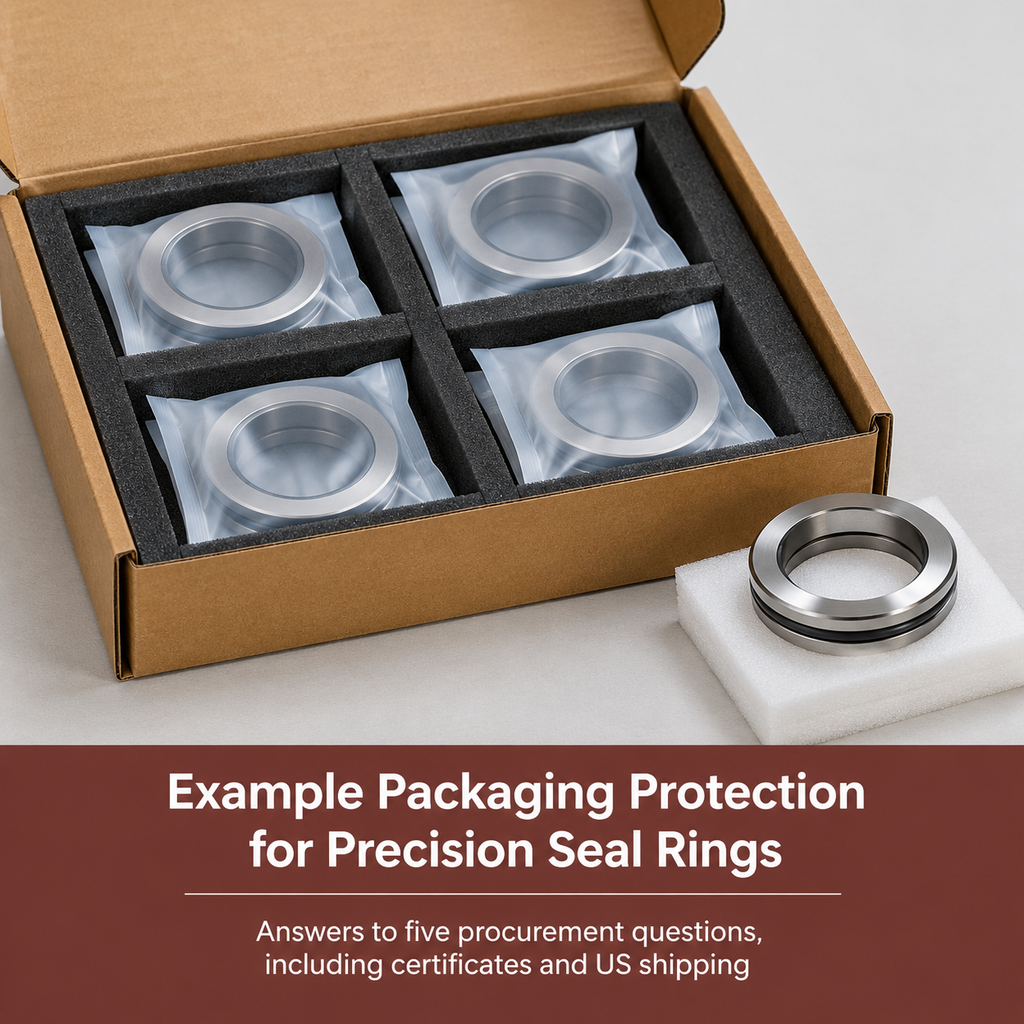
The following answers cover grade approval, drawing feasibility, qualification quantities, documentation, and delivery. Packaging should prevent ring-to-ring contact and keep abrasive material away from lapped faces.
Takeaway: Confirm the entire supply scope before ordering, including protection of the finished sealing surfaces.
Request a Quote for Custom Tungsten Carbide Seal Rings
A release-ready specification links the fluid and mating face to an approved carbide grade, then defines measurable geometry and acceptance criteria.
- Material: Verify binder chemistry, binder percentage, WC grain size, and hardness.
- Drawing: Separate flatness, roughness, parallelism, and runout.
- Supply: Confirm MOQ, lead time, documentation, face protection, and US delivery terms.
Final takeaway: An agreed drawing and inspection plan are the basis for a meaningful quotation—not hardness alone.
FAQ
How should I select the binder and WC grain size for abrasive or corrosive service?
Screen binder compatibility against the actual fluid chemistry, concentration, and temperature first. Then balance WC grain size and binder fraction for abrasion, toughness, and mounting loads. Nickel-bonded carbide may outperform cobalt-bonded carbide in some corrosive media, but it is not universally suitable. Require the proposed grade’s verified material data and evaluate the mating face.
Which tolerances, face flatness, and roughness should I put on the drawing?
State OD, ID, thickness, fits, datums, face flatness, roughness, and any parallelism or runout requirements separately. Numerical examples in this guide are not capability guarantees. Manufacturability is confirmed through review of the actual geometry, machining access, mounting method, inspection setup, and acceptance criteria. Record agreed exceptions before ordering.
What is the MOQ, and can I request a qualification batch?
MOQ is quotation-specific; no universal minimum is stated here. You can request a qualification batch and identify its testing purpose and quantity. Availability and pricing depend on grade, blank availability, tooling, geometry, finishing, and inspection requirements. Confirm both the trial quantity and subsequent production quantity in the inquiry.
What determines lead time, and which certificates and reports are supplied?
Lead time depends on material availability, any required sintering, grinding and lapping, quantity, and inspection scope. Confirm it after drawing approval. Request the required material certificate, batch traceability, hardness results, and dimensional or face-inspection reports in the RFQ; their availability and scope must be agreed. Do not assume third-party certification or any particular certificate format is included.
How should sealing faces be packaged, and what is needed to quote US shipping?
Specify clean, nonabrasive individual protection, separation that prevents face contact, and a rigid cushioned outer package. Confirm packaging compatibility with your cleaning process. For a US freight quote, provide quantities, delivery address and ZIP code, required arrival date, preferred transport, and delivery terms. The quotation should clarify shipment weight, dimensions, and responsibility for import clearance and charges.